





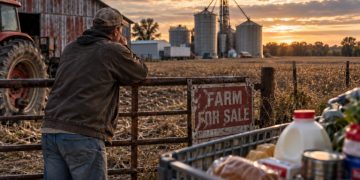


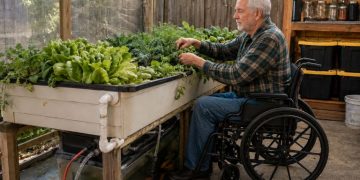


There is an exercise I think every prepper should try once. Stand in the middle of your house and imagine leaving it, not for a weekend but for good, with a hard limit on what can come along. Maybe everything has to fit in one vehicle, or a wagon, or onto your own back.
The moment you accept that limit, the things around you divide into two groups that looked like one a minute earlier. There are things you own, and there are things you actually need.
Human beings have been making that distinction for thousands of years, and the lesson is consistent. Once carrying capacity becomes the binding limit, usefulness wins.
People Who Moved Regularly Learned To Own Differently
Some Native peoples of the Great Plains lived highly mobile lives, especially after horses transformed what a family could move. The National Park Service puts the consequence plainly, noting that abandoning permanent or semi-permanent villages for a mobile lifestyle meant owning and carrying fewer possessions.
What strikes me is where the artistry went. NPS describes most Plains artwork as decoration on things people carried and used daily, including tipis, clothing, carrying cases, pipes and musical instruments. The beautiful objects and the working objects were largely the same objects.
The numbers underneath this are humbling. Before horses, a travois pulled by a dog carried something like sixty to eighty pounds across snow and grass, which means an entire household moved in loads a man could lift. Horses let families haul much more, and as the Smithsonian puts it, travois increased in size and so did tipis.
Knowledge travelled with them as well. NPS records that Athabascan groups in Alaska moved seasonally within a defined territory to obtain food, which meant knowing where fish would run and how to rebuild camp on arrival. We spend heavily on objects because objects are easy to count, and knowledge has no shelf. Take a knowledgeable person away from his equipment and he can usually rebuild, while taking equipment from somebody who never learned how it works leaves an expensive collection doing very little.
The Oregon Trail Turned Every Pound Into A Decision
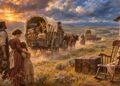
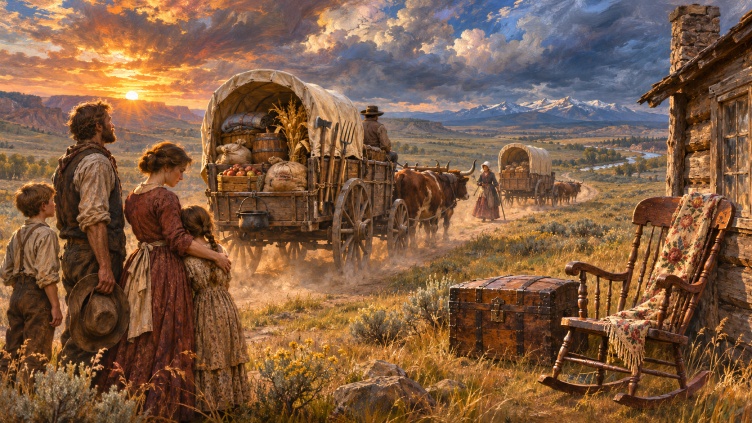
The covered wagon gives us a harsher version of the same problem. A typical wagon held a little over 2,000 pounds, and federal trail materials put the practical ceiling near 2,400 pounds before the oxen began to suffer.
That sounds generous until you remember what had to fit. A family faced a four-month journey across 2,000 miles carrying food, bedding, clothing, cookware, repair parts, farm tools, seed, medicine and the possessions meant to furnish a home at the other end. There was so little spare room that nobody rode except infants and the elderly.
Some of the reckoning happened before anybody left. NPS describes favorite pieces of furniture being left behind to make room for plows, seeds, food and tools. Joseph Ware’s 1849 emigrant guide shows what families hoped to bring if space allowed: books, musical instruments, family albums, jewelry, china, fine linens, iron stoves and furniture.
The rest happened on the road. NPS notes that not long after leaving Missouri, dumping excess items was a common sight, and the route filled with abandoned goods as families cut weight to spare the animals. The hierarchy that emerged was blunt, and NPS states it without softening: tools, guns and food were considered vital, and heirlooms were not.
Seed stayed because it was next year’s food, and spare wagon parts stayed because a broken axle could end everything. Every possession was judged against one question, which may be the most useful thing the trail has to teach us. Can this help us reach the destination, or help us build a life once we arrive?
I do not think we need to be that ruthless, but every prepper benefits from knowing the order things fall in.
The Amish Still Found New Settlements Every Year
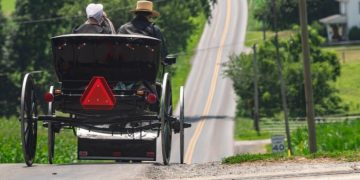
The Amish give us a living version of household relocation, at a larger scale than most assume. The Young Center for Anabaptist and Pietist Studies put the Amish population of North America at roughly 421,200 adults and children as of June 2026, and reported that 43 new settlements were established during the previous year. New settlements are typically small, often only a few families in a single church district.
The reasons are practical: farmland at reasonable prices, nonfarm work, rural isolation, proximity to relatives, and sometimes the resolution of church or leadership conflicts.
What interests me is not the logistics but the company. They move with a community behind them, and Amish mutual aid can mean dozens of people carrying furniture, boxes, tools and supplies on the day. Community itself becomes a form of carrying capacity.
That changes the arithmetic, because a household does not need three copies of every tool if a neighbor owns one and people genuinely help each other. In a group of families one brings carpentry while others bring equipment, livestock experience or extra hands. Modern preparedness pushes us the other way, toward owning everything and solving everything alone. There is real security in that and I believe in it, but the garage eventually fills, and twelve people with useful skills can rebuild more effectively than one person with twelve thousand pounds of equipment.
Pack The Things That Create Other Things
These examples all point me toward equipment that produces rather than equipment that waits. A bag of food disappears as we eat it, while seed produces more food. A sharpening stone restores an edge again and again, a sewing kit keeps clothing in service, a saw and an axe turn raw material into fuel and shelter, and knowledge weighs nothing at all.
The best emergency possessions tend to be the ones that let you create, repair, preserve or replace something else.
One Day You May Have To Choose
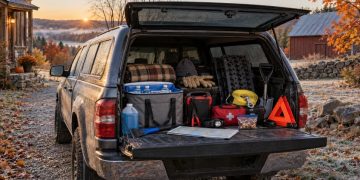
Most of us will never cross two thousand miles behind oxen. Evacuation creates the same problem at a smaller scale, though, whether the cause is wildfire, flood, a hurricane or a house that has become uninhabitable.
One moment you are at home, and the next you are beside a vehicle with more belongings than space, which is a terrible time to work out what matters. History has run that experiment many times over, and when the load grew too heavy it was comfort and possessions that fell away first.
So walk through your house sometime and imagine the wagon standing outside, then decide what earns a place in it.
Others Are Watching Now:



Resources
NPS. The Plains Indians.
https://www.nps.gov/articles/000/the-plains-indians.htm
NPS. Transportation (Knife River Indian Villages).
https://www.nps.gov/articles/transportation.htm
Smithsonian NMAI. A Song for the Horse Nation.
https://b.asp.si.edu/exhibitions/horsenation/travel.html
NPS. Ethnographic Landscapes of Denali.
https://www.nps.gov/articles/aps-v5-i1-c15.htm
NPS. Traveling the Emigrant Trails.
https://www.nps.gov/articles/000/traveling-emigrant-trails.htm
BLM. Packing the Wagon.
https://www.blm.gov/sites/default/files/docs/2024-01/Packing%20the%20Wagon%20(3-5).pdf
Young Center. Amish Population Profile 2026.