
















Basic sewing skills are a life skill. Up until the 1950’s, most families purchased cloth and sewed much of the clothing they needed at home. Those who could afford it had clothing tailored. Americans spent 12-14% of their annual income on clothing compared to the 3% the average American spends today. (Quartz Media, 2026) We owned less clothing but were better dressed, better shod and we maintained our clothing and footwear. Until the last few decades, virtually everyone knew how to sew. We also created far less clothing-related waste.
The case for fewer but better clothes is that it’s better for the planet, better for the people who make them, better looking for the people who wear them, and better for survival. When the container ships stop, would you rather be dressed in polyester or wool? Do you want Styrofoam shoes or re-sole able leather boots?
Basic sewing skills are necessary to maintain quality clothing, footwear, load bearing equipment, packs, tents, tarps and other survival equipment.
Sewing Equipment
Sewing needles are issued in the diminutive SRU-16/P survival kit to sew with thread untwisted from the inner nylon strands removed from the outer kernmantle sheath of 550 cord. They are also issued in MIL-F-6218 survival fishing kit, to sew with fishing line. You will find sewing needles in any pocket survival kit worth carrying both because they are that important and because they take up so little space that there’s no excuse to leave out such a useful item.
While the sewing kit I use most is usually a small kit in my Go Bag, I also carry safety pins, needles and thread in my Pocket Survival Kit, we also have a large home sewing kit, a heavy-duty sewing machine, and carry a very capable repair kit in our car camping gear.
The sewing gear you need depends on the project at hand. I carry a pair of SolKoa Grip-S universal tool handles and a pin vise in my Go Bag that grip even the tiniest tool shanks. This saves space by eliminating tool handles.
- Thread – While you can sew with improvised thread or even natural fibers, thread doesn’t take up much space and is much more effective. I carry thread in light and dark natural colors in two materials: polypropylene and Kevlar.
- Darning Yarn – This yarn should match the yarn in your socks in both size and material.
- Sewing Needles – Sewing needles with sharp points are commonly used for sewing clothing but their small eye makes them difficult to use with improvised thread. That said, sometimes they are the right tool for the job and they don’t take up much space.
- Chenille Needle – This needle features a sharp point and a long, large eye, so it can be used with improvised thread, sinew or catgut, but doesn’t make a big hole like a sail needle. If you could only have one needle in your survival kit, this one is a good candidate, but it would break in heavy canvas or leather and few kits are too small to hold more than one sewing needle.(Reader’s Digest Association, 1995)
- Darning Needles – Darning needles have large eyes to accommodate thick yarns and blunt tips to separate strands of yarn without cutting them. They are used for woven wool products like quality hiking socks.
- Awl Needles – Speedy Stitcher sewing awl needles are great for punching through heavy canvas and leather but they are easiest to use with some sort of small pin vise handle.
- Sail Needles – Sail needles are large, strong triangular point that extends up the shaft. They have large eyes and are made for sewing heavy leather and canvas. The sharp point and triangular body help them. I like the English sail needles by W. Smith & Son. #14 and #15 are good sizes for survival use.
- Thimble – A thimble or palm is just a bit of metal or leather with divots in it to push needles through though fabric without making holes in your hands. If necessary, one can be improvised.
- Needle Threader – This is a diamond shaped wire affixed to a handle or a small flat hook that can pass through the eye of a needle to help you thread it. If you’re young and have good eyes and steady hands, you can probably thread needles without one, but fine motor can become compromised by the cold, injury, hunger, dehydration, fear, and other factors that present during survival ordeals.
- Buttons – A small sewing kit should also contain a small selection of buttons. You can also sew extra buttons to your clothing to ensure you will have them handy when you lose one. Additionally, they are useful for adding suspenders to clothing or hiding escape gear by hanging it in between layers of clothing by hanging it from a button with a lark’s head knot.
- Safety Pins – I prefer brass safety pins because they don’t rust. They are useful in a variety of sizes ranging from size 000 (3/4” or 19mm long) up to kilt pins or blanket pins. Safety pins can temporarily mend a tear, turn a blanket into a sleeping bag and have too many survival uses to list.
- Fabric, Leather, & Adhesive Tape Patches – Some repairs require additional material. This can be in the form of material, iron-on or adhesive patches.
- Cutting Tool – You’ll need a tool to cut thread. You can include a small set of folding scissors in dedicated small sewing kits or plan to use a knife you already carry. I was fortunate to find a few surplus German sewing kits that came with high-quality German made folding sewing scissors. Slip-N-Snip scissors made in USA are another good choice. Don’t bother with junk folding scissors made in China.
- Beeswax – I don’t carry beeswax in my sewing kit, but I always have at least a beeswax candle stub in my fire kit. Beeswax strengthens thread, helps knots hold, lubricates zippers in freezing temps, and is useful in leatherwork, dentistry, medicine, fire starting and more.
- Cotter Pin or Bobby Pin – Cotter pins were used to repair external frame backpacks and to fish pull cords back through channels on sleeping bags, hoods, sacks, rain gear and so on.
- Instructions – I am a fan of including instructions with survival gear because the person using it might not be at 100% and you never know who it might be. If you’re hazy on your stitches, knots, or how to darn socks, it will be a big help.
I designed my kit after studying expedition sewing kits, including the old Chouinard Expedition Sewing Kit. Its main feature is that the included cotter pin forms a T-handle with the small pin vise used as a lightweight awl. I once saw one sell for nearly $500 on an auction site. Pro tip: You don’t need to spend $500 to equip yourself with an OG-level expedition sewing kit, and unless you’re over 55, everybody’s going to think you bought a Chouinard kit to try to impress people anyway. Just buy a pin vise pin vise on Amazon, drill a hold in the handle and save yourself $470.
Darning Socks
Aside from being unseemly, holes in your socks lead to blisters, chafing and discomfort. Untreated, they can eventually lead to more serious conditions that can compromise your mobility and eventually your health. Experienced survivalists take foot care seriously. You can read some of my footcare tips in my previous articles on foot travel.
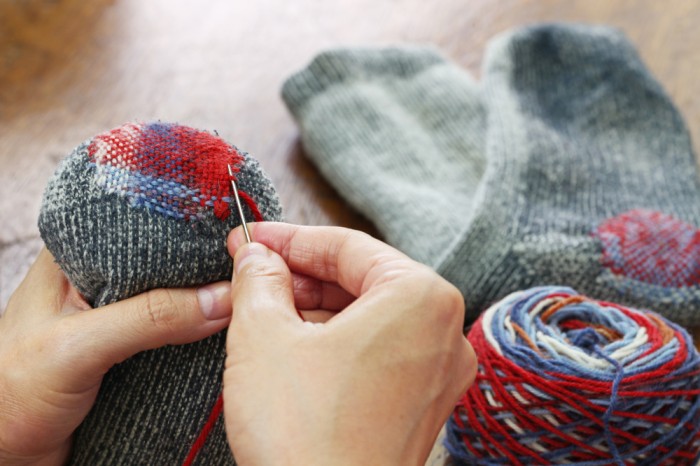
There is more than one way to properly darn a sock. If you catch the hole early while it is small or you just want to add cushion a worn spot, you can duplicate the stitch. To do this, you simply take a darning needle and appropriate sock darning yarn and go over the existing stiches with another piece of yarn about a foot long. Start an inch away and pass over the spot you are reinforcing by an inch, so it doesn’t strain the fabric around it. Pull your stiches tight, but not too tight, or the fabric will pucker.
For bigger holes, you can use either a woven patch or a knitted-on patch. The woven patch is easier, so that is what I’ll focus on here.
Use a darning egg or mushroom for patches. In a pinch, you can use a lightbulb, a round rock, a tennis ball or another object of similar size and shape. Stick it into the sock to help the sock keep its shape. Pull it tight enough so that the sock is stretched out a little and secure it place with a rubber band, string or whatever you have handy. If the sock is loose, your stiches will be messy. A darning egg helps you get the tension right when you pull your stitches tight, preventing pucker marks which result in blisters.
Start the woven patch by running a basting stitch around the hole in a square. Basting stitching is sewing speak for a temporary stitch to hold or guide the real work. Once stitch a square around the hole, create a warp, by anchoring each stitch of yarn just beyond the square and running all the way across the square, creating the warp lines. (In weaving, warp lines are the vertical threads.) Then weave the weft perpendicular to the warp, passing over the first warp thread and under the second, over the third, and so on across the row. (In weaving, weft threads are the horizontal threads woven through the warp lines.) Alternate the pattern on each row, going over where you went under and under where you went over and so on. When you’re done, secure the ends and you’ll have a nice square patch!
Clothing
Clothing repairs are easily made using the small sewing kit, as are modifications or adaptations on the fly. Some repairs can be made with adhesive or iron-on patches.

Canvas & Leather
Our ancestors worked leather with tools of bone, antler, stone flakes and wood. They tanned it with brains, bark and smoke. Leather repairs are usually effected with an awl, sail needles (or glover’s needles for finer work), heavy waxed thread, and sometimes a leather patch or thong.
Survivalist and outdoor writer Bradford Angier suggested adding a few copper rivets to your repair kit. (Angier, 1956) This may wander beyond sewing kit territory but it’s sound advice when riding horses or using pack animals outfitted with leather harness.
Summary
Use simple stiches and a tiny kit to repair work pants, socks, canvas, and leather. Sewing is a solid life skill and a must-know survival skill that’s good for your wallet and the planet and makes you more self-reliant.
References
Angier, B. (1956). How to Stay Alive In the Woods. New York: Black Dog & Leventhal Publishers, Inc.
Quartz Media. (2026, August 7). The Case for Fewer—but Better—Clothes. Retrieved from qz.com:
https://qz.com/189904/the-case-for-fewer-but-better-clothes
Reader’s Digest Association. (1995). Complete Guide to Sewing. Pleasantville, NY: The Reader’s Digest Association.
Others Are Watching Now: