











Survivopedia
  • HOME
  • GENERAL PREP
    • All
    • Disaster Scenarios
    • EMP
    • Natural Disasters
    • Survival News
    • Survival Skills

    The Strangest Things People Stockpiled, And Why They Were Right

    Why I Keep My Whole Backup Kit In One Faraday Dry Bag

    How The Amish Would Handle A Sudden EMP Better Than Most Of Us

    Flock Cameras Aren’t Speed Cameras: What They Record, Keep, And Share

    The First Frost Kit: What Goes In The Truck By Mid-October

    What The Old Women Did Between Harvest And Frost

    Twenty-Five Years Later: Teaching A Generation That Wasn’t There

    The Day Preparedness Changed: What 9/11 Still Teaches Us 25 Years Later

    Mental Walkthroughs: Running Realistic Drills In Your Head Before The Crisis Hits

    • SHTF SCENARIOS
      • Survival Skills
      • Disaster Scenarios
      • Natural Disasters
      • WATER
      • FINANCIAL
      • WAR & CONFLICTS
      • emp
    • EQUIPMENT
      • Bug-Out-Vehicle
      • Firearms
      • COMMUNICATION
    • ENERGY
      • ENERGY
      • Energy Sources
      • Electric Equipments
      • Consumption Control
  • WEAPONS
    • All
    • Cold Weapons
    • Firearms
    • Regulations

    When Chickens, Wood Stoves, And Burn Barrels Become Violations

    Field Reloading

    Field Reloading

    Fully Automatic Firearms? No Thanks!

    Are Alternative Weapons Practical in a Post-Disaster World?

    How To Travel With A Firearm

    The Ultimate Survival Knife: How to Pick the Right One

    A Sharp Edge: Choosing the Best Survival Knife for Prepping and Self-Defense

    Is There a Place for “Fast Draw” in Survival?

    Indispensable Gear for your EDC Core Layer

    • Firearms
    • Cold Weapons
    • Defense
    • Privacy & Data Protection
    • Regulations
  • FOOD
    • All
    • Cooking
    • Farm Animals
    • Farming
    • Food Storage
    • Hunting
    • Plants & Gardening

    Why Your Steak Keeps Getting More Expensive, And Why Prices Won’t Drop Anytime Soon

    Why Our Grandparents Never Threw Away Cooking Fat

    10 Wild Mushrooms Worth Knowing: Food, Health, And Traditional Uses

    Farm Bankruptcies Are An Early Warning

    Export Bans Are The Loudest Signal In Food

    Why So Much Of Your Supply Chain Runs Through A Single Building

    Waist High, No Weeding: Aquaponics For Elderly And Disabled Preppers

    The Hidden Cost Of Inflation: How Shrinking Products Warn You About Scarcity

    7 Survival Foods I Always Keep, And How Much Is Too Much

    • Food Storage
    • Cooking
    • Farm Animals
    • Hunting
    • Plants & Gardening
  • Store
  • Newsletter
No Result
View All Result
Survivopedia
No Result
View All Result
Home FINANCIAL

Food Bank Lines Are Already Long And Winter Hasn’t Started

I have started watching one place almost as closely as the grocery store, and that is the local pantry.

When flour disappears from shelves I pay attention, and the same goes for cheap brands vanishing first or purchase limits appearing without warning. But another signal shows up before the average shopper notices anything, and that is more families asking for help.

In an October 13 report, PBS NewsHour said more than five million people have lost their SNAP benefits since the One Big Beautiful Bill Act took effect, a law that changed eligibility and work requirements and shifted more costs to states.

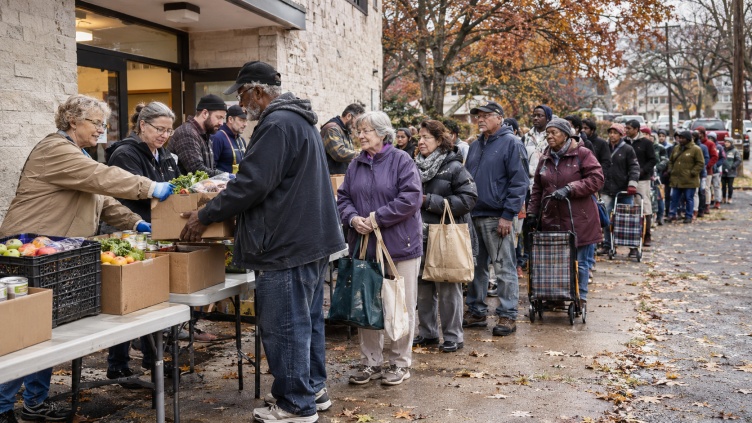
The local detail is what stayed with me. In Central Virginia, SNAP participation is down more than 15 percent, while Dennis Hatchett, who runs the hunger relief group Feed More, told PBS he has seen a 20 percent rise in pantry visits. Fifteen percent fewer people on the program, twenty percent more at the pantry door, and winter has not started yet.
A Full Grocery Store Tells You Less Than A Full Pantry Line

Walk through a supermarket and everything may look normal. The shelves can be fully stocked while thousands of families in the same community struggle to afford what is on them, which is why pantry demand deserves treating as an economic signal.

Families almost always cut somewhere else first, switching brands, leaning on credit cards, delaying bills and borrowing from relatives before anyone asks for charitable food.

Feeding America’s survey at the end of September reached more than 1,200 people who had experienced food insecurity or received charitable food. 60 percent said they did not feel financially stable, 48 percent had delayed bills such as rent or medical expenses to afford groceries, and 52 percent had used credit cards, loans or borrowed money to keep food on the table.

81 percent said people in their community are dealing with long-term financial stress rather than temporary hardship. By the time the pantry line gets longer, a great deal has already happened inside those households.

There Are Hard Numbers On Both Sides Of This

The law set a payment error rate threshold of 6 percent and moved more costs to the states, and the latest federal figures show why that provision exists. USDA reported a national SNAP payment error rate of 10.62 percent for fiscal year 2025, amounting to more than $10 billion in improper payments, with only ten states under the 6 percent mark. Agriculture Secretary Brooke Rollins said the rates were further proof that state accountability is severely lacking.

Those who oppose the changes point at different facts. The error rate counts underpayments alongside overpayments, most errors appear to be unintentional administrative mistakes, not fraud, and paperwork requirements can remove households who do qualify. GAO has put outright fraud closer to a billion dollars a year.

Both cases rest on real numbers, and I am not going to settle the argument here. Whatever the reason a household lost purchasing power, that family needs dinner tonight, and when enough reach that point at once the strain has to move somewhere.

Food Banks Cannot Simply Replace A Federal Program

What matters for preparedness is the scale, since SNAP is enormous next to the charitable food system. USDA figures put average monthly participation in fiscal year 2025 at 42.1 million people, with benefit costs of roughly $95 billion. A church pantry cannot absorb a gap that size by asking the congregation for another bag of canned beans. Food banks were built to supplement a federal program, not replace one.

The charitable system is also receiving less federal food. The Emergency Food Assistance Program normally provides more than a fifth of all food moving through Feeding America network food banks, and roughly $500 million less went through it last year. Reporting from Indiana this year found one food bank receiving 34,000 pounds of that food between January 1 and mid-February, against 143,000 pounds a year earlier.

That is one state, not a national average, but it shows the shape of the problem. None of this means the national food supply is collapsing, only that local safety nets have less room for another shock.

Winter Is When The Pressure Becomes Visible

The calendar matters, because November is not January. Heating costs have not peaked, holiday spending has barely started, severe weather has not disrupted transportation, and school breaks will soon shift meals back into the home.

Betty Hayes of Moments of Hope Food Pantry told PBS she had two weeks’ worth of food in her warehouse, where earlier in the year she had a two-month window. A pantry holding two months of inventory has options when something goes wrong, and one holding two weeks has little room for surprise.

So I would watch for longer lines, smaller amounts per household, urgent appeals for staples, or a pantry turning people away. Those signals may never reach national television, but they say more about my neighborhood than any stock market number.

Check Your Own Shelves, Then Help Properly

I do not look at growing food-bank demand and think about hoarding, but about removing my own household from the problem.

November is a good time to make sure several weeks of ordinary food are already in rotation: rice, beans, oats, pasta, canned tomatoes, canned meat and cooking oil. Food we already eat, and nothing exotic. If a storm lands or prices jump we are not rushing into the same store as everybody else, and not competing for charitable food somebody else needs more.

If you want to help, call the pantry and ask what it needs, and consider money over groceries, since Feeding America reckons every dollar helps provide at least ten meals.
A Gauge Of How Much Cushion Is Left

A food pantry is one of the few places where economic pressure becomes physical and countable.

I would not look at a warehouse falling from two months of food to two weeks and predict empty grocery stores. I would conclude the community has less cushion than it had in January, and winter tends to add new problems on top of old ones. A family barely making the grocery budget in November has no room for a furnace repair, and neither does a pantry operating close to empty.

So I watch the pantry lines the way I watch the shelves, not because I expect disaster tomorrow, but because preparedness begins with noticing where pressure builds before everybody else is forced to notice it.

Others Are Watching Now:

Resources

PBS NewsHour. Cuts to SNAP Benefits Push Many Americans to Seek Help from Food Banks. (October 13, 2026)
https://www.pbs.org/newshour/show/cuts-to-snap-benefits-push-many-americans-to-seek-help-from-food-banks

USDA FNS. FY2025 SNAP Payment Error Rates.
https://www.livenowfox.com/news/usda-fy-25-state-payment-error-rates-snap-benefits-shows-10-1-billion-improper-payments-nationwide

CBS News. Is the Food Stamp Program Rife with Fraud and Waste?
https://www.cbsnews.com/news/snap-payment-errors-food-stamps-fraud-2026/

Feeding America. 2026 Elevating Voices: Insights Report.
https://www.feedingamerica.org/research/community-solutions-hunger

Feeding America. New Survey of Neighbors Facing Hunger Shows Why Sustained Demand for Food Assistance Requires a Stronger Response. (September 29, 2026)
https://www.prnewswire.com/news-releases/new-survey-of-neighbors-facing-hunger-shows-why-sustained-demand-for-food-assistance-requires-a-stronger-response-302892019.html

USDA FNS. SNAP National Level Annual Summary.
https://fns-prod.azureedge.us/sites/default/files/resource-files/snap-4fymonthly-1.pdf

Indiana Public Media. Local Food Banks Struggle Amid Stall in Federal Funding.
https://www.ipm.org/news/2026-03-05/food-banks-short-on-food-amid-stall-in-federal-funding

ShareTweet
Alec Deacon

Alec Deacon

Alec Deacon is the owner of Backyard Liberty.com. He’s very passionate about survival and he’s constantly looking for the best ways to protect his family. He used to work as a hygiene officer in a well-known US company, being in charge with food safety. In the time spent there he learned a lot about food: cooking, storing, freezing, transporting… basically everything that has to do with food safety. He is also a huge fan of outdoor living. Fishing carp is one of the things he loves most and it just happens that fishing is also one of the oldest and most basic survival skill.

Leave a Reply Cancel reply

Your email address will not be published. Required fields are marked *

  • Trending

  • Comments
  • Latest
How To Make Pemmican, The Ultimate Survival Food (Video)

How To Make Pemmican, The Ultimate Survival Food (Video)

January 12, 2026

How the Amish Would Respond to Grid Down

November 17, 2025
Top 10 Vehicles For Your EMP Survival

Top 10 Vehicles For Your EMP Survival

May 19, 2026
Chloroform

How To Make Chloroform For Survival

October 13, 2025
The Ugly Part of Water Purification: Top 5 Mistakes You Make

The Ugly Part of Water Purification: Top 5 Mistakes You Make

September 29, 2025
How to Preserve Eggs Like the Pioneers Did

How to Preserve Eggs Like the Pioneers Did

October 14, 2025
Top 6 Survival Rifles And Why You Need One

Top 6 Survival Rifles And Why You Need One

429
Top 5 Bug Out Locations In The US

Top 5 Bug Out Locations In The US

257
Top 10 Vehicles For Your EMP Survival

Top 10 Vehicles For Your EMP Survival

162
10 Items You Need To Hoard

10 Items You Need To Hoard

148
How To Store Flour, Sugar And Rice For Survival

How To Store Flour, Sugar And Rice For Survival

141
alaska landscape

A Prepper’s Story: Headed To Alaska To Survive Off-grid

118

Food Bank Lines Are Already Long And Winter Hasn’t Started

November 10, 2026
Moving A Household: What Each Culture Packed And What They Abandoned
Moving A Household: What Each Culture Packed And What They Abandoned

November 9, 2026

Why Safe Water May Be The Most Important Thing I Store

November 5, 2026

Why Your Steak Keeps Getting More Expensive, And Why Prices Won’t Drop Anytime Soon

November 3, 2026

Why Our Grandparents Never Threw Away Cooking Fat

November 2, 2026

Keeping Peace At The Table Through The Midterms

October 30, 2026

No Result
View All Result


  • Privacy Policy
  • Terms&Conditions
  • Contact
  • Newsletter

© 2026 SURVIVOPEDIA

No Result
View All Result
  • HOME
  • GENERAL PREP
    • SHTF SCENARIOS
      • Survival Skills
      • Disaster Scenarios
      • Natural Disasters
      • WATER
      • FINANCIAL
      • WAR & CONFLICTS
      • emp
    • EQUIPMENT
      • Bug-Out-Vehicle
      • Firearms
      • COMMUNICATION
    • ENERGY
      • ENERGY
      • Energy Sources
      • Electric Equipments
      • Consumption Control
  • WEAPONS
    • Firearms
    • Cold Weapons
    • Defense
    • Privacy & Data Protection
    • Regulations
  • FOOD
    • Food Storage
    • Cooking
    • Farm Animals
    • Hunting
    • Plants & Gardening
  • Store
  • Newsletter

© 2026 SURVIVOPEDIA