

























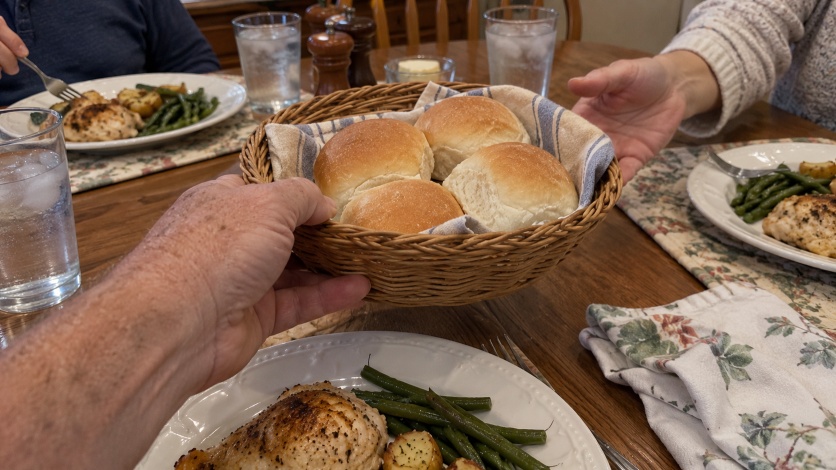
Election week has a way of following people into rooms where it does not belong.
The television is on. Phones keep lighting up. Somebody reads a headline aloud, another rolls his eyes, and then somebody says one sentence too many. Suddenly dinner is an argument between people who were eating peacefully five minutes earlier.
A midterm is supposed to be the quieter kind of election. It is never quieter at the table, and there is a reason. Midterms run heavy on county and state races, so the argument is often about a sheriff, a school board or a commissioner. Somebody you may see at the feed store on Saturday.
Families need a plan for election week the same way they need one for bad weather. Not because politics does not matter. It does.
But the people around your table will still be there after the votes are counted, and that deserves protection too.

Decide The Rules Before The Argument Starts
The worst possible time to invent a rule is when two people are already angry.
So I prefer simple house rules, settled in advance. No shouting. No insults. Nobody gets called stupid for how he votes. And nothing else gets dragged in, which means no spouses, no grandchildren, no religion, no money, and none of the old family arguments.
One matters as much as the rest. If somebody says he is finished talking about politics for the night, he is finished, and nobody reopens it.
I would add one meal a day that stays politics-free. News off, phones elsewhere, and two or three topics ready before people sit down, because a subject change only works when you have somewhere to change it to.
The same rules hold in writing. A message sits in a phone, gets reread, gets screenshotted, and reaches somebody who was never in the conversation. Anything written in anger is better left unsent until morning.
And everybody gets one sentence that ends things without a loser. “We are probably not going to settle this tonight” works, and walking away does not mean the other person won.
One last habit, and it is the most useful of the lot. When something heats up, ask the man what worries him most about it before explaining why he is wrong. People often find the disagreement is not the one they assumed. Two men may both want safer communities and disagree entirely about how to get there, and knowing that makes the person across the table human again.
Do Not Turn A Relative Into A Category
This may be the ugliest habit modern politics has given us.
We stop talking about our brother, or our daughter, or the neighbor who patched the roof, and start talking about people like you. The moment that happens the actual person disappears and becomes a representative of a group we already decided we dislike.
So I hold on to everything else I know about him. The one who votes differently may also be the one who drove me to an appointment, sat up with me in a hospital corridor, or raised children I am proud of. He may be the first person I call when something goes badly wrong.
A ballot choice does not erase that.
Keep Contempt Out Of The House
Anger passes surprisingly quickly. Contempt lasts.
It is one thing to tell somebody I think he is wrong. It is another to say I cannot respect anyone who believes that. The disagreement is then no longer about policy but about whether the other person deserves respect at all.
Families recover from arguments all the time. Recovering from contempt is much harder, and some never do.
There is also somebody small in the room taking all of this in.
Grandchildren retain almost none of the political content they overhear. They retain the tone exactly. They are learning whether people who disagree can still eat together, and whether a relative who votes differently is somebody to argue with or somebody to write off.
And if you are the oldest person at that table, you set the temperature whether you intend to or not. Everybody is watching to see what is permitted. That is not a job I asked for, but it is real.
Whatever gets modelled this week is what those children carry into their own kitchens in thirty years.
Remember Who Will Actually Show Up
This is the thought that keeps the business in proportion.
If a tree comes down across my driveway tomorrow, the people on television are not coming to move it. If the power goes out for three days in February, I am far likelier to be relying on the neighbor whose yard sign annoyed me than on any politician whose sign I put in my own.
That dependence gets less hypothetical every year, which is something a man notices as he gets older.
Real life is local.
Family is local.
Community is local.
Preparedness runs on trust, and trust is hard to build with people you have spent years treating as enemies.

The Table Will Still Be There
There will be a result, and some at your table will be pleased while others are angry or quietly relieved. Give them room. No victory laps, and no reopening it the next morning.
Make breakfast. Feed the animals. Call somebody you love. Keep living.
I will not remember half the political stories that feel urgent this week. I will remember who was sitting at the table.
I will remember who stopped coming.
At a certain age you start counting the chairs, and you learn that an empty one is almost never worth whatever was said to empty it.
So vote according to your conscience. Pay attention. Have opinions, and strong ones if that is who you are.
Then come home and remember that the person across the table is more than a vote to you.
Election results change.
The people you love are much harder to replace.
Others Are Watching Now: