

























I count it as a blessing that everyone in my home shares my interest in preparedness and that we all participate in preparedness activities as a family. That hasn’t always been the case, and it can be a tough row to hoe when some or all of the other members of your family don’t share your enthusiasm for preparedness.
Otherwise reasonable people sometimes fall victim to cognitive bias, logical fallacies, or rhetorical devices and refuse to prepare for emergencies. Understanding these mental barriers is often the first step toward helping family members see the value and necessity of emergency planning.

With other family members, you may need to reframe your preparedness efforts in such a way that they don’t know that they’re preparing. With still others, you may have to limit the resources you commit to preparedness efforts, but most people recognize that some level of emergency preparation is both responsible and necessary.
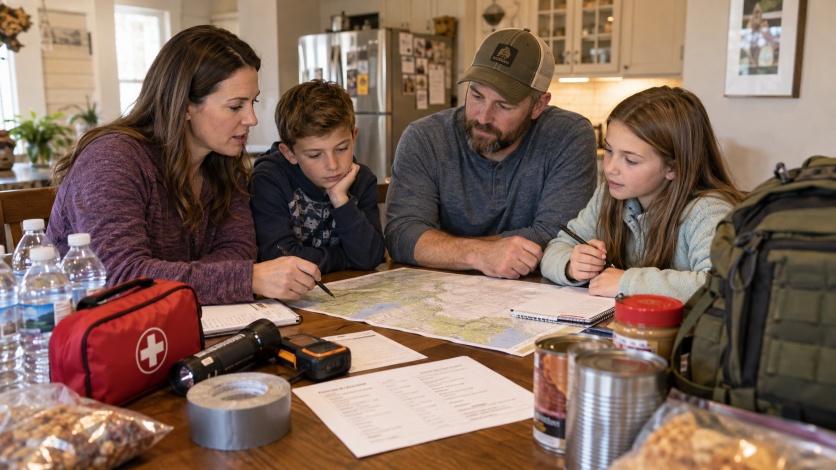
In all of these cases, your family will benefit from regular meetings where everyone can speak, plan, and share responsibility for your family’s readiness.
More Effective Response to Emergencies
For every member of the family to understand their roles and responsibilities in an emergency and for them to “buy in” to them, you have to hold family meetings. (Preparation Call Editorial Team, 2026) Without family meetings you’ll just be individuals responding as individuals.
Humans evolved to respond as families. Families are synergistic, meaning that they are greater than the sum of their parts. Humans are smarter as families than we are individually. We make more effective survival plans and decisions as a group, than we do individually.
A strong family is a beautiful thing. The young benefit from the wisdom of the old. The family cares for the young, the elderly and the infirm.
More Effective Communication
I learned about empathetic listening from Stephen Covey and it’s in the 5th Habit in his book 7 Habits: “Seek First to Understand, Then to Be Understood.” (Covey, 1989)
So often, when we are supposed to be listening, we aren’t really listening. We are instead working on formulating the next thing we want to say.
In empathetic listening, you are not listening to respond, you are listening to understand, and you can let the person you are listening to know that you understand by restating what they told you, reflecting both the content and the emotion. You can also phrase it as a question to ensure that you are understanding.
I have found that once I really understand the other person, I begin to see things from their point of view. Sometimes it leads me to reconsider or soften my position a little bit.
Collective Decision Making
People take ownership of a plans that they help create. Let kids volunteer for tasks they can accomplish. Make sure everyone is involved in decision making. Some of your preparations may take slightly different forms that you imagined, but that’s part of parenting. We figure out what’s important to our kids and learn all about it to help them grow.
For family council meetings to be effective, there has to be real dialogue between all family members. It’s not enough just to all be present in the same room while mom or dad ticks the boxes on an agenda. If that happens, the kids might be in the room, but their minds will wander elsewhere.
Stronger Relationships
My grandfather was a master of preparing without making it look like emergency preparedness. He was a physician in the nuclear program, one of few physicians with experience treating victims of ionizing radiation from actual nuclear weapons, but you would never have known it and there was zero fear in his preparedness. I only recognized many of his “projects” around his properties after studying emergency preparedness for decades.
My four-year-old knows mommy and daddy’s names. He goes camping, hiking and boating. He learns how to use simple tools. He helps in the garden. He helps plant our garden, waters it, cares for it, harvests it, and helps prepare the food. He can treat a simple scape. All of this is teaching him preparedness.
Preparing your family for emergencies is a responsible behavior. As parents, we sacrifice so much for our children. As we serve them, our love for them grows. As the children serve the family and family members serve each other, family bonds also grow.
Tips for Effective Family Council Meetings
- Make it a Habit – Keep the first council short and make the meetings habitual. To be effective, family council meetings must occur regularly.
- Make Decisions – These can be family members agreeing to perform specific actions, making rules, making plans or deciding SOPs. “We don’t open the door for strangers without Dad or Mom present, we talk to them over the intercom.”
- Make Sure All Family Members are Included – Family councils may look different. Not every one has a father, mother, 2.5 kids, grandma, and a golden retriever. Single parent families can have family councils too and family members can join via technology if necessary, such as a son or daughter away at college.
- Make Sure All Family Members are Understood, Appreciated and Trusted – Everyone should be heard, have something to do, and be appreciated for what they do. Make sure that even the youngest have their say. Get everyone working together toward your common goals but listen first. The goal is for everyone to join in the dialogue. If it’s just mom and dad doing all the talking the kids’ minds will start wandering. (Admin, 2026)
- Keep It Positive – The “fearful doomsday prepper” is a Hollywood trope created to entertain the ignorant. I don’t know any fearful or negative preppers, but don’t fall for it and become the first. Focus on solutions.(Wallace, 2025) Make it fun. Ham it up for the little ones. Incorporate activities that older kids enjoy and they will look forward to them.
- Start By Planning for Real World Scenarios – Start the common simple stuff like flat tires, minor injuries and short power outages. Then work on bigger threats like fire safety, kidnapping and home invasion. Eventually you can work your way up to the worst-case scenarios and Black Swans.(Taleb, 2007) Be sure to tailor plans to your family’s needs. If someone has an allergy, make sure everyone knows how to administer Epi-pens. If someone has limited mobility, make sure you plan for that. If you live in tornado alley, you should be doing tornado drills. You get the idea.

- Make it Active – It was hammered into me in training, “You’ll fight the way you train.” It’s true. If you train, then you will do what you trained to do when an emergency happens. Get everyone familiar with the contents of their packs. Include lots of drills and role plays. Work your way up to timed bugout drills to surprise camping trips. Training helps reduce fear, panic, confusion and paralysis in emergencies. Work in the garden. Go camping. Let the kids use everything in their bags. Unless they are used to getting what they need from their pack, it may not even occur to them to open it in a real emergency. Everybody needs to build muscle memory with their gear.
- Make Sure Everyone Understands Your Emergency Plans – Making sure everyone understands your plans is a big part of keeping them safe. Do your kids know what to do if they hear the smoke detector? Do they know what it sounds like? Do they know where to meet up if they have to leave the house? Do they know what to do if they get lost? Kids need to be involved in the discussions, but they also learn by doing. Keep plans simple for the little ones and give them as many repetitions as they need.
- Create Tools to make It Easy – I am a fan of checklists, wallet trifolds with emergency information and the like as memory aids in emergencies. (Yeah, I’m so old I still carry a wallet. I still carry cash too, and both have saved me plenty of grief in emergencies.)
- Update Plans & Supplies – Create reminders to periodically update plans, photos, information and supplies with expiry dates. Food, batteries and many medicines need to swapped out every so often.
Summary
Hold regular family meetings where everyone can speak, plan, and share responsibility for safety and readiness.
Others Are Watching Now:






References
Admin. (2026, August 31). How to Hold a Family Council That Actually Works. Retrieved from ldsvoices.org:
https://blog.ldsvoices .org/family-council-that-works/
Covey, S. R. (1989). 7 Habits of Highly Effective People. New York: Simon & Schuster.
Preparation Call Editorial Team. (2026, October 1). The Role of Family Discussions in Emergency Planning: Steps for Effective Communication and Preparedness. Retrieved from preparationcall.com:
https://preparationcall .com/the-role-of-family-discussions-in-emergency-planning/
Taleb, N. N. (2007). The Black Swan: The Impact of the Highly Improbable. New York: Random House.
Wallace, H. (2025, March 14). How to Hold a Meaningful Family Council (Even with Busy Schedules!). Retrieved from ldsdaily.com:
https://www.ldsdaily .com/home-and-family/how-to-hold-a-meaningful-family-council-even-with-busy-schedules/