








Survivopedia
  • HOME
  • GENERAL PREP
    • All
    • Disaster Scenarios
    • EMP
    • Natural Disasters
    • Survival News
    • Survival Skills

    Shackleton: Six Hundred Days And Not One Man Lost

    7 Habits Veterans Have That Most Preppers Don’t

    The Strangest Things People Stockpiled, And Why They Were Right

    Why I Keep My Whole Backup Kit In One Faraday Dry Bag

    How The Amish Would Handle A Sudden EMP Better Than Most Of Us

    Flock Cameras Aren’t Speed Cameras: What They Record, Keep, And Share

    The First Frost Kit: What Goes In The Truck By Mid-October

    What The Old Women Did Between Harvest And Frost

    Twenty-Five Years Later: Teaching A Generation That Wasn’t There

    • SHTF SCENARIOS
      • Survival Skills
      • Disaster Scenarios
      • Natural Disasters
      • WATER
      • FINANCIAL
      • WAR & CONFLICTS
      • emp
    • EQUIPMENT
      • Bug-Out-Vehicle
      • Firearms
      • COMMUNICATION
    • ENERGY
      • ENERGY
      • Energy Sources
      • Electric Equipments
      • Consumption Control
  • WEAPONS
    • All
    • Cold Weapons
    • Firearms
    • Regulations

    When Chickens, Wood Stoves, And Burn Barrels Become Violations

    Field Reloading

    Field Reloading

    Fully Automatic Firearms? No Thanks!

    Are Alternative Weapons Practical in a Post-Disaster World?

    How To Travel With A Firearm

    The Ultimate Survival Knife: How to Pick the Right One

    A Sharp Edge: Choosing the Best Survival Knife for Prepping and Self-Defense

    Is There a Place for “Fast Draw” in Survival?

    Indispensable Gear for your EDC Core Layer

    • Firearms
    • Cold Weapons
    • Defense
    • Privacy & Data Protection
    • Regulations
  • FOOD
    • All
    • Cooking
    • Farm Animals
    • Farming
    • Food Storage
    • Hunting
    • Plants & Gardening

    The Thanksgiving Price Tag Is A Warning Label

    8 Uses For The Leaves Everyone Else Bags Up

    The Last Garden Day Of The Year

    Why Your Steak Keeps Getting More Expensive, And Why Prices Won’t Drop Anytime Soon

    Why Our Grandparents Never Threw Away Cooking Fat

    10 Wild Mushrooms Worth Knowing: Food, Health, And Traditional Uses

    Farm Bankruptcies Are An Early Warning

    Export Bans Are The Loudest Signal In Food

    Why So Much Of Your Supply Chain Runs Through A Single Building

    • Food Storage
    • Cooking
    • Farm Animals
    • Hunting
    • Plants & Gardening
  • Store
  • Newsletter
No Result
View All Result
Survivopedia
No Result
View All Result
Home HOME & SHELTER Community

Money Without Banks: Wampum, Store Credit, And The Amish Cash Economy

There is a strange assumption buried inside modern preparedness, which is that if the banking system stopped working we would all immediately start bartering. A dozen eggs for a gallon of gasoline, ammunition for a sack of flour.

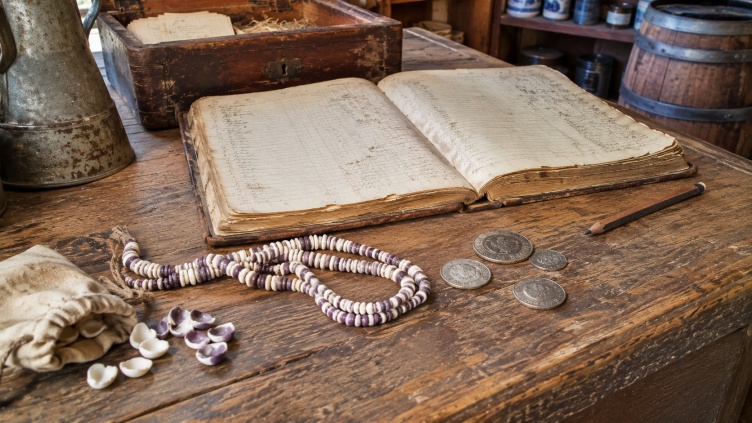
People have traded for thousands of years without debit cards, and they did not spend their days haggling over how many chickens a pair of boots was worth. They built other systems, where shell beads carried meaning, a merchant’s ledger remembered what you owed, and neighbors extended credit because they knew who you were.

The common thread is not barter. It is trust, which turns out to be the part worth preparing.
Wampum Was Never Simply Money

Most of us learned the simplified version, that Native Americans used wampum as money, which is partly true and mostly misleading.

Wampum was white and purple beads worked from whelk and quahog shells, and making it took labor and skill. Among the Haudenosaunee it carried meaning far beyond purchase, since a strand or belt stood for the authority of a spoken message, a treaty required a great deal of it, and the designs worked as a way of remembering events. The Oneida put the standard bluntly, since any statement not accompanied by wampum was likely false or trivial. Indigenous nations did not regard it as currency the way Europeans understood money.

Then colonists arrived, called it Indian money and put it to a use of their own. Massachusetts was valuing it for small transactions by 1637, and the last recorded exchange of wampum as money was in New York in 1701. Nothing magical happened to the shells along the way, since enough people simply agreed they could settle a debt.

The Country Store Was The Payment Network

Coin was scarce in colonial America, since English coins drained away paying for imports and the foreign coins left behind circulated at inconsistent values. So the general store became the clearing house.

Picture a farming community where cash is thin and your wheat will not be cut for three months, though today you need nails, salt and lamp oil. The merchant knows you, hands over the goods and writes what you owe in his ledger. That was book credit, and no fringe practice.

Here is the number that reorganized how I think about this. In one study of colonial merchant account books, roughly ninety-nine percent of purchases were made on credit, about one percent in cash, and under half of one percent by barter. Barter was not the backup system. It was a rounding error, and credit was the economy.

Those accounts ran a year or more before settlement, and some sat open for nearly thirty years. Customers could even transfer a debt to another account with the merchant’s approval, which made those books a clearing house for a whole community’s obligations.

You Settled Up With Whatever You Had

Nearly half of repayments came in goods, a quarter in cash, and the rest in labor, third-party payments and notes. A storekeeper took pork, fish or grain, assigned a value and credited the account.

Through all of it the pound stayed the unit of account even when no coin changed hands. People had not abandoned prices, they had separated the measure of value from the thing used to pay it.

That also solved barter’s central problem. If I grow potatoes and need boots the shoemaker may not want potatoes, and we are stuck. If the store credits me for the potatoes and the shoemaker keeps an account there, neither of us has to want the other’s goods at the same moment. Instead of a payment processor remembering it, the man behind the counter remembered it in ink.

What the arrangement needed is the thing we have less of now. The merchant was not pulling a credit report, he was asking whether this man would pay him back, and he answered from knowing your family, your farm and whether your harvest had failed. Credit was personal, which could be unfair and was also hard to break. No outage erases what two neighbors know they owe each other.

What The Amish Actually Do

People like to say the Amish do not use banks, which is simply wrong. Amish farmers and business owners deposit money, write checks and borrow substantial sums to buy farms, and some banks have built their whole operation around serving them. One Pennsylvania bank put in drive-up windows sized for a horse and buggy.

What many Amish households avoid is the consumer finance layer the rest of us treat as ordinary, so credit cards are uncommon and consumer debt stays low. Most Amish borrowers have no credit score, and that bank lends anyway by weighing character, collateral and income in the context of the applicant’s community, with minimal losses for it. That is the storekeeper’s question again, asked with better paperwork.

Mutual aid then covers what insurance usually would. Because these communities generally do not carry commercial insurance, many run an informal plan for large hospital bills, where the congregation takes a special offering a deacon collects door to door. A barn burns and hundreds of people put up a new one in a day. No insurance card changes hands, and value moves anyway.
What I Actually Take From This

I am not expecting the dollar to vanish, and I am not stockpiling cigarettes I would never smoke against some future barter economy. History points somewhere more practical, because when money gets scarce people layer alternatives around it rather than abandoning price.

The likeliest emergency is not currency collapse. It is a storm taking out communications while the bank is solvent and your money is fine, and the card reader does not work. So I keep cash for that, enough for fuel, food or medicine.

I keep a paper record too, covering who I owe, who owes me and loans inside the family. If I were running a farm through a long outage I would write transactions in a notebook, which is exactly what ledgers did for centuries.

Mostly I would rather be useful than warehoused, because somebody who can repair, grow, preserve, cook or produce clean water still has something to trade after the stockpile runs down.

Underneath the cash, the goods and the skills sits the thing I cannot buy the night before an emergency, which is people who trust me and people I can trust. Our ancestors often lived with very little money. They never lived without an economy, because they built one from whatever their community still believed had value.

Others Are Watching Now:

Resources

EH.net. Credit in the Colonial American Economy.

Credit in the Colonial American Economy

Oneida Indian Nation. Wampum: Memorializing the Spoken Word.
https://www.oneidaindiannation.org/wampum-memorializing-the-spoken-word

Young Center for Anabaptist and Pietist Studies. Mutual Aid.

Mutual Aid

The Daily Economy. Banking with the Amish.

Banking with the Amish

ShareTweet
Darren Kelburn

Darren Kelburn

Darren Kelburn is a hands-on experimenter and backyard problem-solver who writes about practical self-reliance. When he’s not testing small-scale food or power systems, he’s usually fixing something around the house or hiking local trails with his family.
Leave a Reply Cancel reply

Your email address will not be published. Required fields are marked *

  • Trending
  • Comments
  • Latest
How To Make Pemmican, The Ultimate Survival Food (Video)

How To Make Pemmican, The Ultimate Survival Food (Video)

January 12, 2026

How the Amish Would Respond to Grid Down

November 17, 2025
Top 10 Vehicles For Your EMP Survival

Top 10 Vehicles For Your EMP Survival

May 19, 2026

7 Habits Veterans Have That Most Preppers Don’t

November 11, 2026
Chloroform

How To Make Chloroform For Survival

October 13, 2025
The Ugly Part of Water Purification: Top 5 Mistakes You Make

The Ugly Part of Water Purification: Top 5 Mistakes You Make

September 29, 2025
Top 6 Survival Rifles And Why You Need One

Top 6 Survival Rifles And Why You Need One

429
Top 5 Bug Out Locations In The US

Top 5 Bug Out Locations In The US

257
Top 10 Vehicles For Your EMP Survival

Top 10 Vehicles For Your EMP Survival

162
10 Items You Need To Hoard

10 Items You Need To Hoard

148
How To Store Flour, Sugar And Rice For Survival

How To Store Flour, Sugar And Rice For Survival

141
alaska landscape

A Prepper’s Story: Headed To Alaska To Survive Off-grid

118

Money Without Banks: Wampum, Store Credit, And The Amish Cash Economy

November 23, 2026

The Holiday Travel Kit: What I Put In The Car Before A Four-Hour Thanksgiving Drive

November 20, 2026

I Didn’t Know What Was Missing From My Survival Kit Until I Found This Straw

November 19, 2026

The Thanksgiving Price Tag Is A Warning Label

November 17, 2026

8 Uses For The Leaves Everyone Else Bags Up

November 16, 2026

The Last Garden Day Of The Year

November 13, 2026

No Result
View All Result


  • Privacy Policy
  • Terms&Conditions
  • Contact
  • Newsletter

© 2026 SURVIVOPEDIA

No Result
View All Result
  • HOME
  • GENERAL PREP
    • SHTF SCENARIOS
      • Survival Skills
      • Disaster Scenarios
      • Natural Disasters
      • WATER
      • FINANCIAL
      • WAR & CONFLICTS
      • emp
    • EQUIPMENT
      • Bug-Out-Vehicle
      • Firearms
      • COMMUNICATION
    • ENERGY
      • ENERGY
      • Energy Sources
      • Electric Equipments
      • Consumption Control
  • WEAPONS
    • Firearms
    • Cold Weapons
    • Defense
    • Privacy & Data Protection
    • Regulations
  • FOOD
    • Food Storage
    • Cooking
    • Farm Animals
    • Hunting
    • Plants & Gardening
  • Store
  • Newsletter

© 2026 SURVIVOPEDIA