






Survivopedia
  • HOME
  • GENERAL PREP
    • All
    • Disaster Scenarios
    • EMP
    • Natural Disasters
    • Survival News
    • Survival Skills

    Shackleton: Six Hundred Days And Not One Man Lost

    7 Habits Veterans Have That Most Preppers Don’t

    The Strangest Things People Stockpiled, And Why They Were Right

    Why I Keep My Whole Backup Kit In One Faraday Dry Bag

    How The Amish Would Handle A Sudden EMP Better Than Most Of Us

    Flock Cameras Aren’t Speed Cameras: What They Record, Keep, And Share

    The First Frost Kit: What Goes In The Truck By Mid-October

    What The Old Women Did Between Harvest And Frost

    Twenty-Five Years Later: Teaching A Generation That Wasn’t There

    • SHTF SCENARIOS
      • Survival Skills
      • Disaster Scenarios
      • Natural Disasters
      • WATER
      • FINANCIAL
      • WAR & CONFLICTS
      • emp
    • EQUIPMENT
      • Bug-Out-Vehicle
      • Firearms
      • COMMUNICATION
    • ENERGY
      • ENERGY
      • Energy Sources
      • Electric Equipments
      • Consumption Control
  • WEAPONS
    • All
    • Cold Weapons
    • Firearms
    • Regulations

    When Chickens, Wood Stoves, And Burn Barrels Become Violations

    Field Reloading

    Field Reloading

    Fully Automatic Firearms? No Thanks!

    Are Alternative Weapons Practical in a Post-Disaster World?

    How To Travel With A Firearm

    The Ultimate Survival Knife: How to Pick the Right One

    A Sharp Edge: Choosing the Best Survival Knife for Prepping and Self-Defense

    Is There a Place for “Fast Draw” in Survival?

    Indispensable Gear for your EDC Core Layer

    • Firearms
    • Cold Weapons
    • Defense
    • Privacy & Data Protection
    • Regulations
  • FOOD
    • All
    • Cooking
    • Farm Animals
    • Farming
    • Food Storage
    • Hunting
    • Plants & Gardening

    The Last Garden Day Of The Year

    Why Your Steak Keeps Getting More Expensive, And Why Prices Won’t Drop Anytime Soon

    Why Our Grandparents Never Threw Away Cooking Fat

    10 Wild Mushrooms Worth Knowing: Food, Health, And Traditional Uses

    Farm Bankruptcies Are An Early Warning

    Export Bans Are The Loudest Signal In Food

    Why So Much Of Your Supply Chain Runs Through A Single Building

    Waist High, No Weeding: Aquaponics For Elderly And Disabled Preppers

    The Hidden Cost Of Inflation: How Shrinking Products Warn You About Scarcity

    • Food Storage
    • Cooking
    • Farm Animals
    • Hunting
    • Plants & Gardening
  • Store
  • Newsletter
No Result
View All Result
Survivopedia
No Result
View All Result
Home SECURITY Food Security

The Last Garden Day Of The Year

There is a Saturday every fall when I want everybody outside. Not an hour here and twenty minutes tomorrow, but one day, one list, and one final push before the garden belongs to winter.

This works far better than letting cleanup drag into December. A hose gets forgotten behind the shed, a rain barrel freezes with water still in it, tomato vines stay on the trellis until spring. Then the first warm weekend arrives and half the work waiting for me is work I should have finished months ago.

So I put a list on the refrigerator days ahead, because once everybody is outside I do not want to spend the morning deciding what needs doing. Then I assign names, since a cleanup works better when “somebody should pick up the pots” becomes “Ben, you have the pots.”
Everybody Gets A Real Job

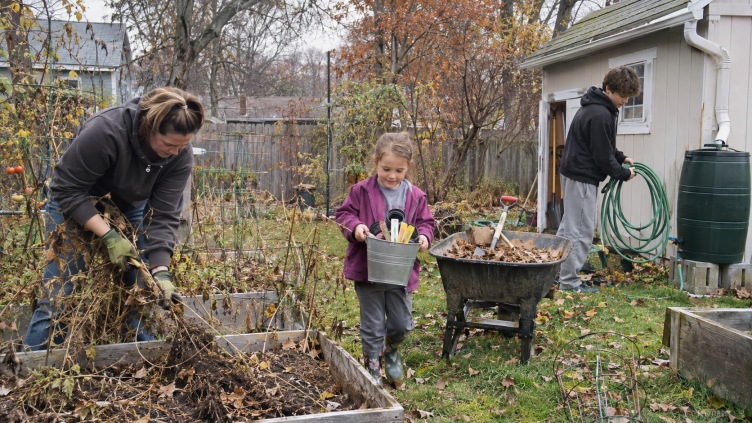
Small children do not need pretend work. I give the youngest a bucket and send them after empty pots, plant labels and dropped clips, and they can move loose leaves where I want mulch. They stay away from diseased plants, sharp stakes, pruning tools and fertilizer. The goal there is partly work and partly memory, because I want them to remember that closing the garden was something the family did, not something Dad did alone outside.

Seven to nine is perfect for clearing shallow-rooted annuals like beans, peas and lettuce. This is where I teach the sorting rule, because not all plant debris is equal.

Minnesota Extension is specific about this. Severely infested tomato, potato and pumpkin material should be bagged and thrown away, while the rest can be piled for compost. Weed seed heads and perennial rhizomes go in the trash too, since a cold compost pile will not kill them.

By ten or twelve I want jobs that take more attention, so they pull larger plants, remove cages and wheel the healthy material to the pile. Children that age are surprisingly good at finding what adults walk past.

Clean The Vegetable Beds, Not The Whole Property

This is the part most fall checklists get wrong.

Illinois Extension advises leaving some flower stems standing instead of cutting everything to the ground, because pollinators rely on hollow stems for nesting and shelter. Leafcutter and mason bees nest inside those stems and emerge in spring, and butterflies overwinter as pupae attached to dry stems. Leaves do the same job, insulating moths and butterflies camouflaged against the litter. If bare lawn is the goal, rake them into the beds.

The exception is the one above, since where disease showed up this year that debris still gets cleaned up. So the vegetable garden gets cleaned, and the whole property does not need to look sterilized.

The Jobs That Cost Money If You Forget Them

This is where teenagers get work that gets expensive when it is skipped.

The hoses come first on the list. Utah State Extension says to disconnect hoses from water spouts to avoid freezing damage, and I have the teenagers drain each one, stretching it downhill before coiling it loosely under cover. Water left in hoses and fittings freezes and expands, and the same goes for irrigation, which USU says to blow out.

Rain barrels I handle myself every year. Minnesota Extension says to drain the barrel completely, remove debris, scrub the inside with a long-handled brush, then remove the hose and screen and store them in a shed. The barrel goes away upside down or covered, and the reason is blunt: any water left inside may freeze, expand and crack it.

One step gets forgotten almost every year. With the barrel gone, the downspout needs a temporary extension so snowmelt runs away from the foundation.

Tools Get Cleaned And Sorted

This is the job I like doing alongside the older children, with every shovel, hoe, rake and hand tool brought into one place. Utah State’s advice is the short version: clean and sharpen them and treat them with oil or another rust-inhibiting product.

Minnesota Extension gets more specific than that. Shovels and hoes get cleaned under running water and wiped dry, metal surfaces can be wiped with 70 percent rubbing alcohol, and a spray of WD-40 goes on before everything is stored in a dry shed.

While we work I make two piles, one ready for spring and one needing repair. I would rather find a cracked shovel handle in November than on the first planting day in April.

Mulch, Then Write It Down

Mulching is the last big job, and one of the few where everybody works together at once. The small ones carry buckets, older children spread, adults move wheelbarrows. Shredded leaves, straw or compost all work, and mulch reduces erosion, protects the soil and eventually feeds it. It also finishes the garden, since bare beds suddenly look tucked in.

Then I hand a teenager the camera and a notebook. We photograph the beds before everything disappears and write down what happened. Which tomato did well, which tasted good but produced nothing, and whether we planted too much zucchini again.

Memory turns generous over winter, and by February I remember every variety as better than it was. The notes are what tell the truth.

When everyone thinks we are done I walk the property once more, and that last ten minutes always finds something. A hose nozzle under the bushes, a watering can, a cage behind the shed, a fertilizer bag in the damp. Then I shut the shed door, and that sound is the end of the season.

Then We Go Inside

This part is not optional, and nobody wanders off alone when the list is done. We go in for hot chocolate, coffee or cider, and we talk about the garden for a few minutes. The tomato plant that got ridiculous, the rabbit that ate what it should not have, the failed pumpkins, the afternoon everybody helped dig potatoes.

A garden should produce more than vegetables. It should also produce family stories.

We celebrate beginnings, because planting day is exciting and everyone imagines what the garden will be. The ending gets less attention, since by November the plants are brown and everybody is tired of them. But closing a garden properly is part of growing one, and it teaches what I want my family to carry: finish the job, look after your tools, learn from what failed, and put things away ready for next time.

Then stop, because winter has its own work and there will be another garden next year.

Others Are Watching Now:

Resources

University of Minnesota Extension. Putting Your Garden to Bed.
https://extension.umn.edu/yard-and-garden-news/putting-your-garden-bed

University of Minnesota Extension. Rain Barrels in the Home Landscape.
https://extension.umn.edu/water-wisely-start-your-own-backyard/rain-barrels

Illinois Extension. Consider Pollinators During Fall Garden Cleanup.
https://extension.illinois.edu/news-releases/consider-pollinators-during-fall-garden-cleanup

Utah State University Extension. November Yard and Garden Tips.
https://extension.usu.edu/news/november-yard-and-garden-tips-2024

ShareTweet
Darren Kelburn

Darren Kelburn

Darren Kelburn is a hands-on experimenter and backyard problem-solver who writes about practical self-reliance. When he’s not testing small-scale food or power systems, he’s usually fixing something around the house or hiking local trails with his family.

Leave a Reply Cancel reply

Your email address will not be published. Required fields are marked *

  • Trending
  • Comments
  • Latest
How To Make Pemmican, The Ultimate Survival Food (Video)

How To Make Pemmican, The Ultimate Survival Food (Video)

January 12, 2026

How the Amish Would Respond to Grid Down

November 17, 2025
Top 10 Vehicles For Your EMP Survival

Top 10 Vehicles For Your EMP Survival

May 19, 2026
Chloroform

How To Make Chloroform For Survival

October 13, 2025

7 Habits Veterans Have That Most Preppers Don’t

November 11, 2026
The Ugly Part of Water Purification: Top 5 Mistakes You Make

The Ugly Part of Water Purification: Top 5 Mistakes You Make

September 29, 2025
Top 6 Survival Rifles And Why You Need One

Top 6 Survival Rifles And Why You Need One

429
Top 5 Bug Out Locations In The US

Top 5 Bug Out Locations In The US

257
Top 10 Vehicles For Your EMP Survival

Top 10 Vehicles For Your EMP Survival

162
10 Items You Need To Hoard

10 Items You Need To Hoard

148
How To Store Flour, Sugar And Rice For Survival

How To Store Flour, Sugar And Rice For Survival

141
alaska landscape

A Prepper’s Story: Headed To Alaska To Survive Off-grid

118

The Last Garden Day Of The Year

November 13, 2026

Shackleton: Six Hundred Days And Not One Man Lost

November 13, 2026

Pain Control When There Is No Morphine

November 12, 2026

7 Habits Veterans Have That Most Preppers Don’t

November 11, 2026

Food Bank Lines Are Already Long And Winter Hasn’t Started

November 10, 2026
Moving A Household: What Each Culture Packed And What They Abandoned

Moving A Household: What Each Culture Packed And What They Abandoned

November 9, 2026

No Result
View All Result


  • Privacy Policy
  • Terms&Conditions
  • Contact
  • Newsletter

© 2026 SURVIVOPEDIA

No Result
View All Result
  • HOME
  • GENERAL PREP
    • SHTF SCENARIOS
      • Survival Skills
      • Disaster Scenarios
      • Natural Disasters
      • WATER
      • FINANCIAL
      • WAR & CONFLICTS
      • emp
    • EQUIPMENT
      • Bug-Out-Vehicle
      • Firearms
      • COMMUNICATION
    • ENERGY
      • ENERGY
      • Energy Sources
      • Electric Equipments
      • Consumption Control
  • WEAPONS
    • Firearms
    • Cold Weapons
    • Defense
    • Privacy & Data Protection
    • Regulations
  • FOOD
    • Food Storage
    • Cooking
    • Farm Animals
    • Hunting
    • Plants & Gardening
  • Store
  • Newsletter

© 2026 SURVIVOPEDIA