


















I have a habit I am not proud of. I buy backup electronics for a grid-down emergency, then leave them on a shelf completely exposed to the same event I bought them for. A spare radio, a backup phone holding documents and photographs, power banks, a GPS, a drive with every family record on it.
Unlike food or water, none of that can be replaced afterward. Whatever kills your radio kills every radio in every store within driving distance at the same moment. The protection either happened in advance or it did not happen.
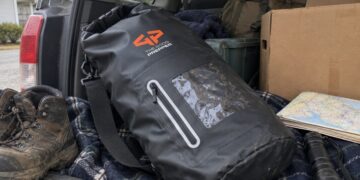
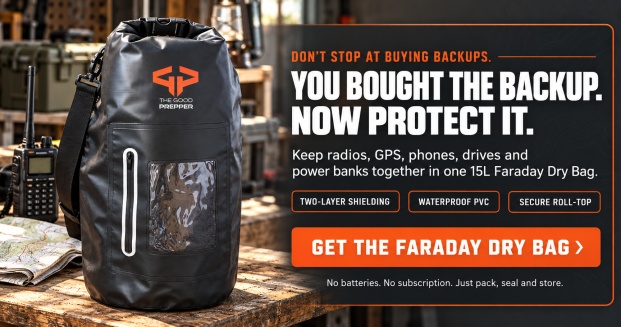
That is what sent me looking at Faraday storage, and what I settled on is the EMP Vault, a 15L Faraday Blackout Bag.
15 Liters Means The Whole Kit, Not One Phone
This is the feature that sold me, and it is the one most people overlook when they shop for Faraday storage.
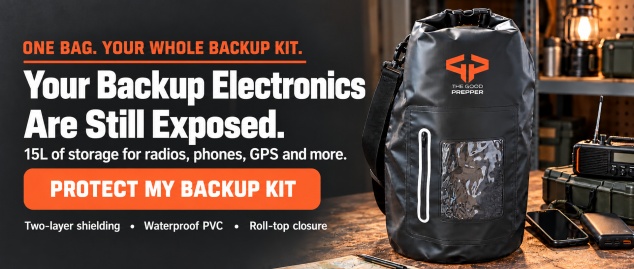
Most Faraday products are pouches. They hold a phone and maybe a wallet, which makes them privacy accessories rather than preparedness equipment. Fifteen liters is a different proposition entirely. That is roughly a small daypack.
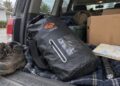
In practice it swallows a laptop, a backup phone, two or three handheld radios, a couple of power banks, a bundle of cables, a GPS unit and several drives, and still closes properly with room left at the top.
That changes what the purchase is for. You are not protecting one device and hoping it carries you. You are protecting a complete second set of electronics, which is what a real backup plan looks like.
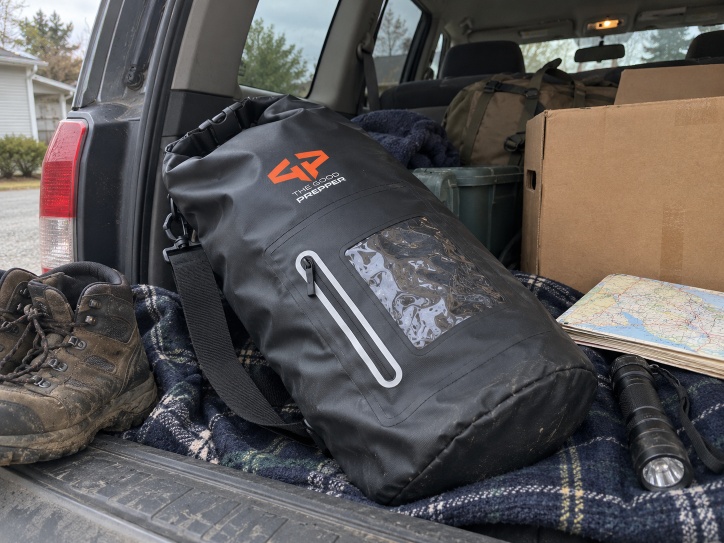
The bag measures 21.5 by 14.6 inches with an 8.5 inch bottom. Heavy-duty waterproof PVC outside, RFID-blocking fabric inside, two layers of shielding, an adjustable strap, and two reinforced D-ring patches on the back panel so it can be clipped or secured rather than just set down.
One Closure, Two Kinds Of Protection
The roll-top with a buckle is my favorite piece of design on this bag, and the reason is not obvious until you think about it.
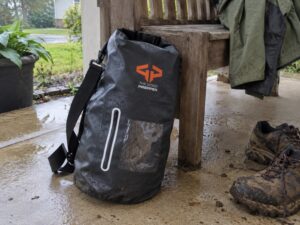
The mechanism that makes a dry bag waterproof is the same mechanism that seals a Faraday enclosure. Fold it, roll it, buckle it, and you have closed both problems with one motion. Nothing about the waterproofing is bolted on, and nothing about the shielding asks you to do extra work.
That matters more than it sounds, because water ruins far more emergency electronics than electromagnetic pulses ever have. Leaking roofs. Flooded basements. A creek rising overnight. An evacuation on foot in the rain. Two years sitting in a damp garage waiting to be useful.
A radio saved from an EMP and then killed by rainwater has not helped anybody. This format covers both, which is the reason I would own one even if I thought an EMP was unlikely.
Two Compartments, Two Jobs
There is a transparent front pocket on the outside, a 6.7 by 9.4 inch window with a side zipper, and once you understand how it works it becomes one of the more practical things about the bag.
The main compartment, the one that rolls shut, is the shielded one. That is where protected gear lives.
The clear front pocket is outside the shielding, which is exactly what you want it to be. It gives you somewhere to carry the phone you are still using, where you can see the screen and reach it in a second, without ever unsealing the compartment holding everything you are protecting.
One bag, two purposes. Sealed storage for the backup kit, quick access for the device in daily use. Keep protected gear in the main compartment and treat the clear pocket as ordinary storage, and the bag does both jobs at once.
I Tested It, And It Passed
This is the part I wanted to confirm before trusting the bag with anything, and it takes five minutes.
I put a phone in the main compartment, rolled the top down, buckled it, and the signal was gone. No bars at all. I called from a second handset and nothing came through. No ring, and no missed call sitting there waiting when I opened it back up. Wi-Fi and Bluetooth dropped the same way.
The best thing about that test is that you do not have to take my word for it. Five minutes and a second phone will tell you the same thing, and I would run it again once a year simply because closures and fabrics wear with handling.
Worth being precise about what that proves, because it is the reason I trust this bag rather than a reason to doubt it. A clean signal test is strong evidence that the enclosure works as an enclosure and that the closure seals properly when you use it right.
Set It Up Once, Then Leave It Alone
Very little else in preparedness asks so little of you after the first afternoon.
There is no subscription. No battery inside the bag that has to stay running. No app, no account, nothing to renew, nothing to update. You pack it, you test it, you store it.
My own routine is to power everything down before it goes in, because a phone left switched on will hunt for a signal it cannot reach and drain itself flat. Then it is a recharge check twice a year and a repeat of the signal test, and that is the whole maintenance burden.
Why It Earns Its Shelf Space
Go and open the drawer where your backup electronics live, and add it up honestly. A backup phone, radios, power banks, cables, a GPS, the drive holding your documents and photographs. For most prepared households that is several hundred dollars sitting unprotected, and for plenty of us it is well past a thousand.
You already spent that money. The only question left is whether it still means anything on the morning you reach for it.
That drive is the part I think about most. Every photograph of your children, the deeds, the insurance policies, the medical records. Food can be replaced. That cannot.
Sizes and current pricing are on the The Good Prepper page.
Store food, because stores can close. Store water, because taps can stop. Keep paper maps, because GPS can fail. And protect the electronics you bought for the day everything else goes wrong, while protecting them is still possible.
Others Are Watching Now: