






















Insurance companies are in the business of measuring risk.
That does not mean they are always fair. It does not mean they always treat customers well. It does not mean every premium increase is justified. But when large insurers start raising deductibles, adding exclusions, refusing renewals, leaving certain markets, or tightening coverage, a prepper should pay attention.
They are telling you something.
Maybe they see more wildfire losses coming. Maybe hail claims are rising. Maybe flood risk is worse than the old maps suggest. Maybe crime is increasing. Maybe replacement costs are climbing faster than families realize. Maybe the power grid, roofing stock, building codes, or local infrastructure are creating losses they no longer want to carry.
Most homeowners treat insurance changes as paperwork.
A prepper should treat them as intelligence.
Insurance Is A Risk Map In Disguise
Every insurance bill carries a message.
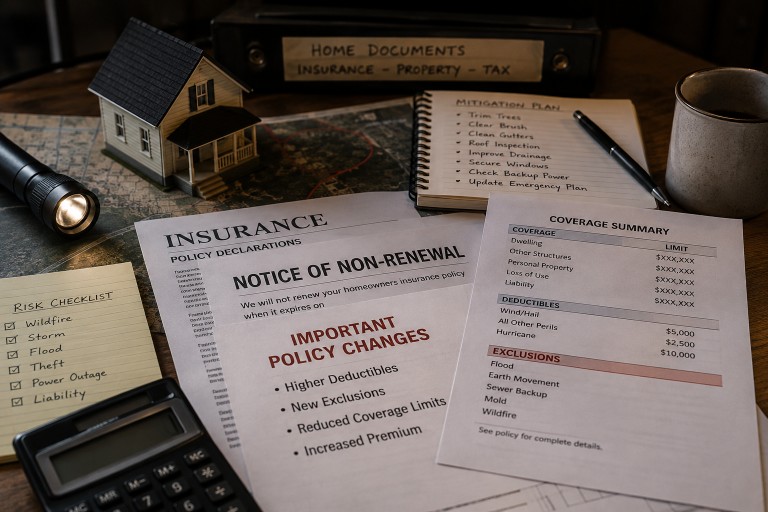
If your premium jumps, your deductible rises, or your coverage shrinks, the company may be reacting to risk in your area. That risk may come from weather, fire, flood, lawsuits, theft, construction costs, aging homes, or poor emergency response.
The company may never say it plainly. You have to read the pattern.
If wind and hail deductibles are rising, storms are the signal. If wildfire coverage becomes harder to find, vegetation, drought, access roads, and fire response times deserve attention. If flood coverage is being pushed harder or excluded more carefully, drainage and elevation matter. If theft claims are affecting rates, your neighborhood security picture may be changing.
Your policy is not just a bill. It is a warning letter written in insurance language.
Rising Deductibles Show Where The Pain Is
A deductible is the amount of loss the company wants you to absorb before it pays.
When deductibles rise in one category, that category deserves your attention. A higher wind deductible tells you storm damage is becoming more expensive. A separate hurricane deductible tells you coastal exposure is being priced differently. A bigger hail deductible tells you roofs, windows, vehicles, and siding may be taking repeated hits in your region.
Do not just complain about the deductible. Ask what would make you less likely to need the claim.
That may mean trimming trees, reinforcing garage doors, replacing a weak roof, adding storm shutters, improving drainage, securing loose outdoor items, or keeping repair materials on hand.
The deductible points toward the threat.
Exclusions Are Even Louder
An exclusion is one of the clearest signals an insurer can give.
If the company will no longer cover something, or only covers it with an extra endorsement, it is telling you that the risk has become too expensive, too common, or too hard to predict under the old policy.
Common problem areas include flood, earth movement, mold, sewer backup, certain roof conditions, wildfire exposure, business use of the home, vacant property, and some types of water damage.
A prepper should read exclusions carefully. Many families only discover what is excluded after the loss. That is a painful way to learn.
If your policy excludes a major local risk, you need another layer of protection. That may be a separate policy, better mitigation, more savings, a relocation plan, or a decision to reduce exposure before the event arrives.
Non-Renewals Mean The Risk Has Crossed A Line
A rate increase says the company wants more money to carry the risk.
A non-renewal says something stronger.
It means the company may no longer want the risk at all, at least under current conditions. That should get your attention quickly, especially if neighbors are receiving the same letters.
One non-renewal may be tied to a roof, claims history, inspection problem, or property condition. Many non-renewals in one area point to a larger pattern. Wildfire zones, hurricane regions, flood-prone neighborhoods, aging coastal properties, and high-crime areas can all become harder to insure.
When insurance starts leaving, property values, mortgage options, and family stability may follow.
A prepper should not wait until the last affordable option disappears.
Watch What Insurers Inspect
Insurance inspections are another source of useful information.
If an insurer suddenly cares about your roof age, tree limbs, brush clearance, electrical panel, wood stove, outbuildings, trampoline, pool, dog breed, cracked steps, old plumbing, or business activity on the property, ask why.
They are looking for losses before they happen.
Some of their concerns may feel annoying. Some may feel intrusive. Still, the list often points to real weak spots. A tree limb over the roof can damage the house. A bad electrical panel can start a fire. Rotten steps can create injury claims. Poor brush clearance can worsen wildfire danger. Old plumbing can flood the home.
If an inspector flags it, do not only think about compliance. Think about survival and repair costs.
Turn Policy Changes Into A Mitigation List
A prepared household should translate insurance changes into practical work.
If wildfire risk is the issue, clear brush, manage trees, clean gutters, harden vents, move firewood away from the house, improve access for firefighters, and create defensible space.
If storm risk is the issue, inspect the roof, secure flashing, reinforce doors, protect windows, clean gutters, anchor outdoor equipment, and keep tarps, fasteners, and basic repair supplies ready.
If flood or water damage is the issue, improve drainage, extend downspouts, grade soil away from the foundation, install water alarms, maintain sump pumps, store items off basement floors, and know where the main water shutoff is.
If theft or vandalism is the issue, improve lighting, locks, cameras, fences, gates, parking habits, and neighborhood awareness.
The policy tells you where to start.
Keep Proof Before Trouble Comes
Insurance claims often depend on proof.
A prepper should document his home before a disaster. Take photos and video of every room, outbuilding, tool set, appliance, pantry area, generator, firearms safe, stored equipment, and major purchase. Record serial numbers. Keep receipts when possible. Store copies of policies, deeds, titles, appraisals, and important documents in more than one place.
Paper copies matter. Digital backups matter too.
After a disaster, stress makes memory unreliable. A clear inventory can make the difference between a weak claim and a better one.
Even if insurance fails you, records help with taxes, disaster assistance, replacement planning, and family decision-making.
Build A Financial Buffer Beyond Insurance
Insurance is useful, but it should not be your only plan.
A policy may have limits. A claim may be delayed. A deductible may be larger than expected. A loss may fall under an exclusion. Replacement costs may exceed coverage. Contractors may be scarce after a regional disaster.
That means a family needs margin.
Keep emergency cash. Reduce debt where possible. Store repair supplies. Learn basic home maintenance. Build relationships with local tradesmen before everyone needs them. Know what you can fix yourself and what requires a professional.
The household that can patch a roof, dry a room, shut off water, secure a broken window, or run backup power has more control during the waiting period.
Review Coverage Before Renewal Season
Do not wait until renewal day to understand your policy.
Once or twice a year, review your coverage with a clear mind. Ask what the policy covers, what it excludes, what deductibles apply, and what has changed. Ask whether flood, sewer backup, earthquake, wildfire, wind, hail, replacement cost, ordinance upgrades, and outbuilding coverage are handled the way you think they are.
Do not assume.
If you live in a high-risk area, talk to more than one agent if necessary. Check your state insurance department for consumer information. Compare options early. Waiting until after a non-renewal letter arrives may leave you with fewer choices.
Preparedness includes boring paperwork.
Big Companies Are Giving You Clues
Insurers may frustrate you. They may overcharge. They may deny too much. They may hide behind fine print. All of that may be true.
But when they change behavior across whole regions, they are often pointing at danger before the public fully accepts it.
Higher deductibles, new exclusions, roof restrictions, wildfire inspections, flood warnings, sewer backup endorsements, cancellations, and market withdrawals all tell a story.
A prepper should read that story.
If insurance is getting harder to buy, harder to keep, or harder to afford in your area, do not treat it as just another bill. Treat it as a signal to harden the home, improve drainage, reduce fire risk, secure the property, document everything, build cash reserves, and reconsider long-term exposure.
Insurance may say no when the risk gets too high.
Your family should not wait until then to say yes to mitigation.
Others Are Watching Now:













































No standard homeowners insurance policy covers nuclear war, electromagnetic pulses (EMP), or coronal mass ejections (CME). These catastrophic events are universally classified as uninsurable “mega-risks” and are explicitly excluded by standard policy language and industry-wide exclusions.