











There is a question that doesn’t get asked nearly enough in the prepping community, and honestly, the silence around it is a little unsettling. We spend a lot of time talking about gear lists, bug-out routes and survival protocols.
Sure, all of that is valuable, and none of it is wasted effort, but somewhere along the way, a lot of us forget to ask the one question that actually gives everything else its weight: what are we doing all of this for?
The gear doesn’t matter if there is nothing behind it worth protecting and the stockpile you’ve worked years for it doesn’t matter if the life you are preserving has lost its sense of direction.
All plans fail in the end, if the only goal is survival for survival’s sake, with no deeper answer waiting on the other side of the emergency. Before you can truly defend a life, you need to know what makes that life worth defending in the first place.
That reflection, uncomfortable as it sometimes is, might be the most important prep you ever do.
Survival Without Meaning Is Just Postponing the Inevitable
Most preppers come to this lifestyle through a specific moment. A natural disaster, a job loss, a health scare, the loss of a loved one or perhaps a news story that finally pushed them past the tipping point.
Whatever the trigger, the initial motivation tends to be fear-based, which is completely understandable. Fear is a legitimate and powerful motivator, but as many end up learning the hard time, fear alone is not a foundation you can build a life on. Fear is definitely not something that will carry you through a genuine long-term crisis.
History gives us plenty of examples of people who survived physically but collapsed inwardly because they had no larger framework to hold onto. Viktor Frankl wrote extensively about this after his experiences in Nazi concentration camps. The people who found a reason to keep going, whether through love, purpose, faith, or responsibility to others, were far more likely to endure than those whose survival had no anchor.
The body can tolerate extraordinary hardship, but the mind needs something more. If you have never sat down and seriously thought about what you are actually fighting for when things go sideways, you are leaving a gap in your preparedness plan that no amount of freeze-dried food can fill.
The People Who Make the Risk Worth Taking
For most preppers, the honest answer to “what are you doing this for” starts with a face. A spouse, a child, a parent, a close friend. Relationships are almost always the core of what drives us toward preparedness, even when we dress the motivation up in more abstract language like self-reliance or community resilience. When you dig down past the tactical layer, you usually find love sitting at the bottom of it.
Some say that it is a weakness, but for me personally, that’s the whole point. Your wife staying up with your sick kid while you sleep so you can take the next shift matters. Your father’s stories at the dinner table matter. The neighbor who brought you soup when you had surgery, the friend who answered the phone at two in the morning, the community that rallied around your family during a hard year, all of that matters enormously.
Relationships are not just the emotional reward of survival, they are what drives our will to live.. People who have strong relational bonds consistently outperform isolated individuals in crisis scenarios. I believe human connection is not a liability, but rather the survival infrastructure.
Take some time to actually name the people in your life who pull this whole effort into focus. Write them down if you have to, but not as a sentimental exercise, and rather as a practical reminder of what you are organizing your preparations around. Knowing clearly who you are protecting changes how you prepare, where you prioritize, and how you behave under pressure.
Values Are the Architecture of a Life Worth Defending
Beyond relationships, values are what give your life its particular shape. And when we talk about values in this context, we are not talking about vague banalities. We are talking about the specific commitments and principles that you would be unwilling to abandon even under severe pressure.
Things like honesty, fairness, loyalty, faith, craftsmanship, stewardship of the land, care for the vulnerable. The particular values will differ from person to person, and that is fine. What matters is that you know yours clearly enough to defend them.
Here is why this is directly relevant to preparedness. When a genuine crisis hits, it almost always creates ethical pressure alongside the physical hardship. Resources become scarce and people make desperate decisions. Social structures get stressed in ways that expose character.
In those moments, your values are the operating system that determines how you respond. A prepper who has never thought seriously about their values is more vulnerable to making choices in crisis that they would deeply regret afterward. The question you should ask yourself is not just whether you survive, but whether the version of yourself that survives is one you can still respect.
Think about what you believe about the dignity of people outside your immediate group. Think about how far you would go to help a stranger, and where your limits are. Think about what you owe to your community and what your community owes to you. These are not abstract philosophical puzzles and they are the decisions that will eventually show up in real life when things get hard.
Purpose Gives Endurance Its Direction
There is a difference between a person who is simply trying not to die and a person who is trying to accomplish something. Folks who have a clear sense of purpose tend to make better decisions, maintain better morale, and contribute more to the people around them than those who are purely in defensive mode.
Purpose can take many forms and it might be tied to a faith tradition and a sense of obligation to serve your community in God’s name. It might be rooted in a professional identity, a craftsman who wants to keep teaching their trade, a nurse who sees their skills as a calling that doesn’t stop when the grid goes down. Sometimes, it’s just generational, a deep drive to preserve something for your children and grandchildren that they can build on.
Whatever shape it takes for you, purpose is what transforms endurance from mere suffering into something that actually produces something. Purpose is the difference between waiting out a crisis and growing through one.
If you do not currently have a clear sense of purpose beyond the immediate goal of keeping yourself and your family safe, that is worth sitting with honestly. Not with anxiety, but with genuine curiosity.
What did you want to contribute to the world before fear started crowding out the other conversations?
What skills or knowledge do you have that others genuinely need?
What kind of community would you want to help build if you had the chance?
Those answers are load-bearing parts of the life you are trying to protect.
The Daily Life That Makes the Defense Worthwhile
One of the more overlooked aspects of this reflection is the texture of ordinary life. Preppers can sometimes get so focused on catastrophic scenarios that they lose sight of the fact that everyday life is also what they are defending.
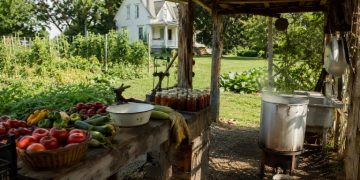
That morning coffee ritual or the garden that produces more tomatoes than one family can eat or perhaps the habit of walking the same trail every weekend and knowing exactly where the deer bed down. These small, recurring pleasures are not trivial. They are, in aggregate, what a good life actually feels like from the inside.
When crisis does come, the people who recover most fully are often those who had rich, textured ordinary lives to return to. They are not just surviving toward an abstract future. They are trying to get back to something specific and beloved. That specificity matters because it gives you something concrete to rebuild toward, not just a vague hope for things to be better eventually.
So, take stock of what you genuinely love about your life right now. The traditions that anchor your year, the hobbies that make you feel like yourself and the sensory pleasures that remind you why being alive is worthwhile. These are not separate from your preparedness work and you will realize, they are the reason for it.
A Last Word
After years of thinking about preparedness from every angle, I keep coming back to this: the people who do this well are not the ones with the most gear or the most elaborate plans, although those things have their place.
The people who do this well are the ones who know themselves clearly enough to know what they are fighting for. They have names on a mental list and they have values they would not trade away for comfort. They have a sense of what they want to contribute and a genuine appreciation for the life they have built. I believe that combination is more resilient than any bunker.
You can prep indefinitely without ever asking the deeper question, and plenty of people do. But I think you will prep with more clarity, more generosity, and ultimately more effectiveness once you have done the uncomfortable work of defining what makes your life genuinely worth defending.
Others Are Watching Now: