






















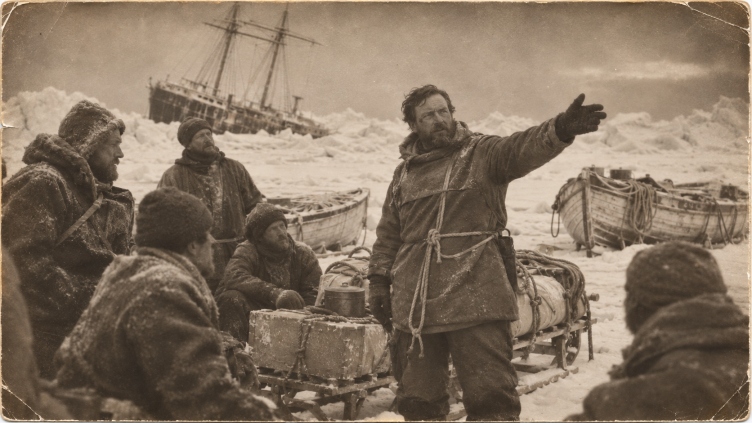
There are leadership books that spend three hundred pages getting people through a difficult quarter at work, and then there is Ernest Shackleton.
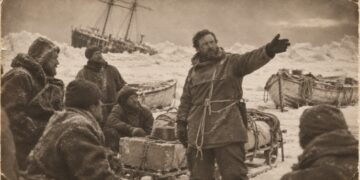
His ship was beset by Antarctic ice in January 1915 and slowly crushed. Endurance was abandoned on October 27 and sank on November 21, leaving twenty-eight men on a moving sheet of frozen ocean with no radio and nobody who knew where they were. They would live on that ice for months, cross open water in small boats, reach an island nobody visited, and send six men across one of the deadliest seas on earth for help. All twenty-eight of them came home alive.
Shackleton lost nearly everything he had planned around, and what remained was a group of cold, frightened men waiting on his next decision.

He Changed The Mission Before Pride Killed Them
Shackleton had sailed south to cross Antarctica, and once the ship was trapped that goal was finished. A poor leader spends dangerous time protecting the old plan. Shackleton changed his, and the mission became bringing the men home.
That sounds obvious from a comfortable chair, and it is much harder after years of preparation and great expense. Your own objective may stop mattering the same way. The house may not be defensible, the route may be blocked, the generator may be dead. At some point, protecting the plan is more dangerous than abandoning it.
Routine Kept Fear From Having All Day
Imagine waking tomorrow knowing there is nowhere useful to go, then doing it again the next morning. That was the real danger, and Shackleton fought it with routine.
Meals stayed regular and the men kept working. There were chores, card games, singing, birthdays, and at one point a game of football on the floe. That sounds ridiculous given the circumstances, and I think it was brilliant. When people have nothing to do but think about how bad things are, fear gets unlimited time to work on them, and a routine gives the day edges.
Food carried the same kind of weight. There was a quiet argument over Shackleton’s reluctance to stockpile seal meat, because preparing for a long stay would have told the men he no longer believed they were getting out. I would not copy that as a rationing strategy, but the point stands. If I am feeding a household through weeks without normal services, I do not want every meal to feel like punishment. Coffee makes morning feel like morning, and something saved for Sunday reminds everyone the week still has one.
The Banjo Weighed Twelve Pounds
When Endurance was abandoned, weight became the enemy. Shackleton set a limit of two pounds of personal possessions per man, making the point by throwing away some of his own things first.
Then he kept Leonard Hussey’s banjo, which weighed twelve pounds, six times the limit he had just imposed on everyone else. He called it “vital mental medicine.”
Men were leaving belongings on the ice because every pound counted, and the leader kept a musical instrument. Not because it helped pull a sled, but because it helped pull the men. The purely practical list is not the complete list. A deck of cards weighs nothing, and children may need one familiar toy.
He Watched The Men As Closely As The Ice
Accounts describe Shackleton keeping the pessimists and troublemakers close to himself rather than letting them form factions, and mixing officers, sailors and scientists so cliques never hardened into divisions. You can have enough water and still lose the group. Resentment builds, two people stop speaking, somebody starts handing out hopelessness, and on drifting sea ice that is dangerous, so the difficult man sometimes needs more attention, not less.
He Knew When Hard Work Had Become Stupid Work
After abandoning the ship, Shackleton tried to haul the men and boats across the ice toward land. After seven days of brutal effort they had covered seven and a half miles in a straight line.
So he did the arithmetic, and it was damning. At that rate the journey would have taken over three hundred days, and they had roughly forty-two days of food. He stopped, made camp, and let the drifting ice carry them instead.
That decision kills one of our favorite survival myths, because effort is not the same as progress. People keep working since stopping feels like surrender, so they dig harder and burn fuel they cannot replace. A leader has to ask whether any of it helps, and when the numbers stopped making sense Shackleton changed the plan.
He Made The Terrible Decisions Himself
When the ice broke up they launched three boats, and after seven days on the water all twenty-eight reached Elephant Island on April 15, 1916. It was dry land, and useless, far outside any shipping route.
So Shackleton took five men and sailed the 22.5-foot James Caird roughly 800 miles across the Southern Ocean to South Georgia, seventeen days of freezing spray and enormous seas, navigating by glimpses of the sun. Twenty-two stayed behind with no guarantee of seeing him again.
They made South Georgia on the wrong side, so Shackleton, Frank Worsley and Tom Crean crossed the island’s unmapped interior on foot, thirty-six hours without stopping. By then survival was not one brilliant decision but hundreds of correct ones made while exhausted, which is the more useful lesson.
Three attempts to return were turned back by ice before he reached Elephant Island aboard the Chilean vessel Yelcho on August 30, 1916. Every one of them was still alive.

Leadership Is Another Prep
One honest qualification belongs on the end. The wider expedition included a separate Ross Sea party on the far side of Antarctica, and three of those men died. When we say Shackleton lost nobody, we mean the twenty-eight he personally led out.
That does not shrink the achievement so much as sharpen it. Shackleton did not save those men by predicting correctly, since his expedition failed almost at once. He saved them because when the plan collapsed he could still lead.
Most preparedness lists have food, water, radios, medicine, fuel and tools, as they should. But if other people will depend on me, I need to prepare my usefulness when everybody is tired, my willingness to change my mind, and my ability to keep fear from owning the room.
You cannot put that in a storage tote. After reading what happened to the men of the Endurance, I am convinced it belongs on the list anyway.
Others Are Watching Now:






Resources
Cool Antarctica. Shackleton Endurance Timeline.
https://www.coolantarctica.com/Antarctica%20fact%20file/History/Ernest_Shackleton_map_time_line.php
Wikipedia. Voyage of the James Caird.
https://en.wikipedia.org/wiki/Voyage_of_the_James_Caird
Wikipedia. Leonard Hussey.
https://en.wikipedia.org/wiki/Leonard_Hussey
Explorersweb. Ocean Camp to Patience Camp: Shackleton, December 1915.
Wikipedia. Ross Sea Party.
https://en.wikipedia.org/wiki/Ross_Sea_party