





















Security, insulation, off-grid hacks, water cache.
There are many reasons that you might want to turn a garden shed, or something similar, into a backup survival shelter:
- Don’t Put All Your Eggs in the Same Basket – Storing everything you own under one roof makes you vulnerable to losing everything you own in a single catastrophic event such as a structure fire, wildfire, flood or looting. You could return home to find that you’ve lost all your food storage, medical supplies, water, equipment, ammunition, weapons … the whole shooting match. If that describes your situation, you might consider creating a “lifeboat” cache. Stock it with the things you would need to start over. Refugees often start over with only what they carry in a small knapsack, but they often suffer great hardship in the process. A lifeboat cache gives you a headstart.
- Improvised Fallout Shelter – Depending on how you design and build it, and where it’s located, a garden shed may make a decent improvised fallout shelter. In fact, there are building plans for just such a project in some of the old civil defense plans.
- Expand Living Quarters – If your brother-in-law’s survival plan is to show up at your house with your sister, her 2.5 kids, grandma and their golden retriever, and you wouldn’t turn them away, you may need the room. There are also security benefits to stacking up in a long duration catastrophe. You need a lot of people to maintain a watch, an LP/OP, perform random patrols, do all the chores, grow food, and keep a retreat running smoothly.
- Budget Safe House – A modified garden shed or similar structure, can give you a place to lay low for a while if it’s tucked out of the way, and camouflaged from view, especially if it’s positioned so that it appears to be on a neighbor’s land. Just build a fence, isolate part of your yard, and make it consistent with the neighboring property. Where I live, it’s not uncommon for someone to section off part of a yard and loan or lease it to a neighbor to garden. When your neighbor puts in a gate, it will look like it belongs to them to anyone who isn’t in the know. This may be much cheaper than purchasing or renting a separate property. Just be sure to consult an attorney about your state’s adverse possession laws before doing this. Otherwise your neighbor could possibly gain a legal claim to part of your land.
Security
If your security-related objective is to protect your family, the only thing proven to stop armed bad guys is armed good guys. You need to stop them or escape. Anything else amounts to a false sense of security.
In high explosive breaching and dynamic entry training, I learned that if determined and intelligent people prepare the battlefield ahead of time, they can turn it into a nightmare, even for an entry team.
First, you need a head’s up to give you time to arm yourself so you can either fight or run.
Radio Motion Detectors
This is the poor man’s version of Dakota Alert and similar ranch security systems that use radios to communicate a motion sensor trip alarm. I have found them for as little as $10 on sale at Harbor Freight.
They can be easily modified, protected from the weather, and camouflaged so that intruders will never know that they tripped the alarm, but you will, even 400’ away, which can be increased by replacing the antenna on the base station with a better antenna. Since they transmit and receive at 433 MHz, the conductor for a full wave antenna would be 69.24cm long or a quarter wave antenna would be 17.3 centimeters long.
I have used these radio motion detectors to protect storage units and vehicles, and they aren’t bad for the price. They run on batteries and will work off grid with rechargeable batteries. You have to check the batteries regularly to ensure that they keep working and are affected by cold, like many thing that run on batteries, but I was impressed with the range.
Area Denial
With radio motion detectors, you’ll know when someone gets within a hundred yards or so using the stock antenna. That gives you plenty of time to make ready … as long as they’re on foot.
Make certain intruders are on foot and buy yourself more time by using area denial tactics to slow them. These include obstacles to vehicles and fences and obstacles to channel and slow foot traffic, causing them to take a longer, more circuitous route. Hedges, trees, planters, fences, guard dogs or even real looking dummy boobytraps. Under most circumstances, you don’t want live booby traps around your home because of the risk to children, pets, livestock, first responders, and all the liability and illegality that would go with it.
Rat Lines
Radio motion detectors give you situational awareness, area denial tactics buy you time, and rat lines enable you to slip away. Rat lines are trails that enable you and yours to escape unseen. They use fences, hedges, culverts, sewers, ravines, groves of trees, brush, junked vehicles, boulders, canals, rivers, lakes, raised beds, ladders (that you pull up as you pass), gates (that you lock as you pass), and so on to keep you safe from observation and direct fire, slow pursers, and enable your escape.
The best ones lead to stashed vehicles that your pursuers can’t follow because they are on foot, don’t have boats, motorcycles, a 4×4 or something like that to follow you. At the very least, they will have to jog hundreds of yards back to their vehicles to pursue you, by which time you’ll be long gone.
Heat
At least up north, the main problem with living in a garden shed, besides not having a sink, toilet or shower, is that they are cold!
Insulation
At least up north, the main problem with living in a garden shed, besides not having a sink, toilet or shower, is that they are cold! Insulating your shed will help keep the cold out and the heat in.
If the shed is on a pad, you’ll probably want to build an insulated wood floor to prevent heat loss to the Earth via conduction.
Insulate the walls, and especially the roof, with faced insulation because heat rises and you can install wall paneling over that to make it feel like a home.
If you can find some reclaimed dual-pane windows, that’s great, but if you’re fixing up a shed, you may not have that kind of cash. If that’s the case, install shutters and blackout drapes instead. They make a huge difference by trapping dead air.
Heat
To heat your shed with a wood stove you’ll need to install a stove, a stove jack, stove pipe, and a spark arrestor. Alternately, you can use a kerosene heater.
Safety
Anytime you seal a shelter up tight and heat it with an open flame, you are at risk of carbon monoxide poisoning. A battery powered carbon monoxide detector or two is well worth the expense. It could save your life.
Heat and flame also put structures at risk of fire. Install fire brick or fire board under and around heat sources, don’t position the heat source between your bed and the door, create an emergency exit, and be ready to put out fire with buckets or sand, water or a fire extinguisher. If you don’t use a wood stove you can install a smoke detector, but if you will be heating and/or cooking with a wood fire, you might set if off more than you’d like.
Off-grid Hacks
You will need more than walls and a roof to live comfortably in your shed.
Solar Power System
It has never been as cheap or as easy to build a small 12v DC solar power system as it is today. Panels can often be had for less than $1 per watt. With solar panels, deep cycle batteries, wiring, a solar charge controller, and a USB hub and you can run radio gear, and USB-powered phones, tablets and fans.
If you add a pure sine wave inverter, you can run low wattage 120v AC electronics and charge batteries for cordless power tools, which are a huge work saver if you need to rebuild your home or work on your shed. This will also enable you to run water pumps.
You could buy an all-in-one unit, but most of them use proprietary architecture components, which means that when they break, you throw them away and buy a new one. That might be convenient for the average consumer, but survivalists need to be able to fix it when it breaks. If you build one yourself, you can fix it by simply storing spares and swapping out the faulty component.
Lighting
LED lighting is inexpensive, effective and safe. Oil lamps and candles are comforting and produce heat. I mainly use oil lamps and candles when I want the heat they produce or I am trying to relax, but they can be dangerous around small kids.
Sanitation
Without proper hygiene sanitation you would invite parasites and disease, and without laundering, clothing and bedding lose their insulative value and shelter bedbugs and mites.
- Shower – Learn to build a shower here.
- Sink or Basin – For dishes and washing hands.
- Laundry – A bucket, plunger, washboard, basin, clothesline and soap are practical for this application.
- Bucket Toilet, Outhouse or Composting Toilet
Water
Especially in the western USA, access to water can be real problem. Not so long ago, people used to travel from water to water. In times past, access to water dictated everything and the day may not be far off when it does so again. Many cities in the Western US are in danger of running out of water.
There are multiple solutions to the water problem:
- Piped Municipal Water
- Access to a Well or Spring
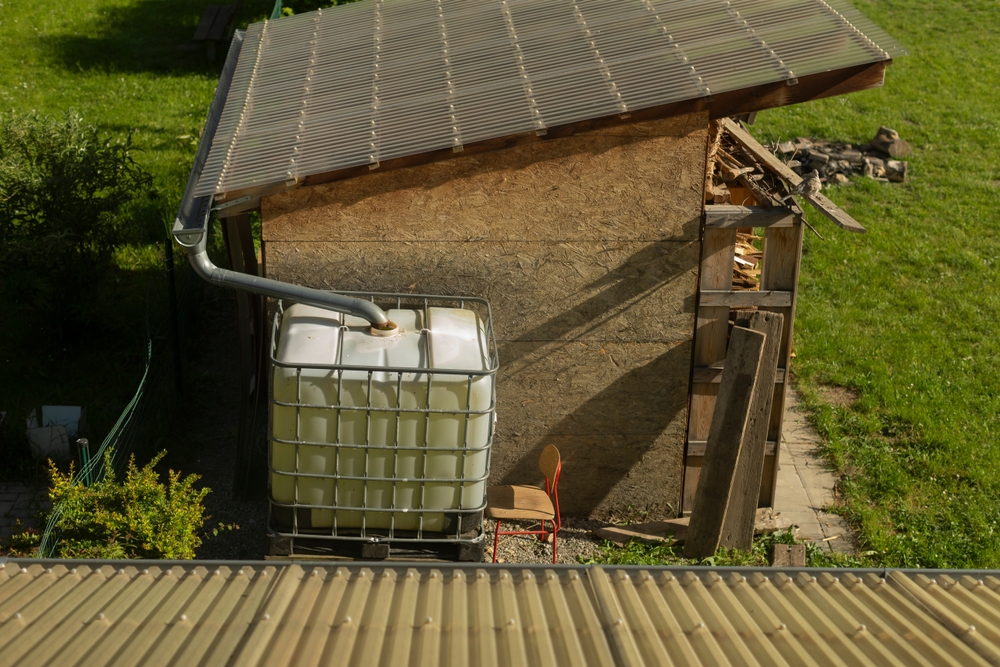
- Rainwater Catchment – Water from permanent rain catchments should be treated to make it potable due to contamination by bird and rodent feces and other contaminants and materials the water contacts should be drinking water-safe.
- Access a Surface Water Source – Must be treated to make it potable.
- Haul Water – If you haul water, use a cart or other mechanical advantage.
Water Storage
However you get your water, it’s best to also store water for emergency use. Even if you have access to municipal water, any disaster that knocks out the power long enough causes a “boil water order” to go into effect. A flood, earthquake or even simply maintenance on the water system can contaminate the municipal water supply or stir up sediment present in cisterns, tanks and pipes, turning the water that comes out of the tap muddy or rusty.
55-gallon barrels are usually the cheapest way to go. Just be sure to get new, food-grade barrels. Learn how to store water for 25 years of more without rotation here. If you want your shed to double as an improvised fallout shelter, water storage needs to be cover and should be resistant to overpressure. This can be accomplished inexpensively by digging a pit, lining it with plastic barrel liners, building a cover and mounding earth over it. If it is positioned above a dugout, water can be accessed in the shelter via a siphon. You can find detailed plans for this and other aspects of fallout shelters in the book Nuclear War Survival Skills by Cresson H. Kearney. (Kearney, 1987)
Summary
There are many good reasons to turn a shed into a backup survival shelter or use these same methods to improvise a shelter. By paying attention to security, insulation, heat, and water, you can turn a shed, or similar structure, into a tiny home or shelter.
Others Are Watching Now:





References
Kearney, C. H. (1987). Nuclear War Survival Skills. Cave Junction, Oregon: Oregon Institute of Science and Medicine.