











In this line of work, I have had the pleasure of reading many books on why some people survive while others do not and researched thousands of survival ordeals to the answer that same question.
Why People Survive
If you add up the attributes of survivors described in the several books on why some people survive while others do not, they are: knowledge (and the ability to apply it), adaptability, ingenuity, intelligence, conditioning (including training), resilience, perseverance, tenacity, instinct, and luck, and “the will to survive.” Under this last category fall the intangibles: hope, purpose, love, and faith. (Gonzalez, 2005) (Kamler, M.D., 2004) (Leach, 1994) (Ripley, 2008) (Sherwood, Faith, 2009)
According to John Leach, (Leach, 1994) instead of freezing or panicking in response to disaster (as the 90% of people do), survivors keep calm and respond in a meaningful way.
According to Amanda Ripley, (Ripley, 2008) Survivors pass through three phases: denial, deliberation, and the decisive moment.

Why people survive is often a function of the aforementioned attributes, but several of the cited authors posit that it can also often be attributed to the ability to make and then execute lifesaving decisions under stress. Survivors either do something that saves lives, or they don’t do something that costs lives.
Survivors nearly always make mistakes. They just make small ones and manage to avoid the catastrophic life-ending mistakes.
The Will to Survive
“The will to survive” is a constant theme throughout the aforementioned because the mind nearly always gives out before the body.
Hope, purpose, love and faith are what give survivors their will to survive. They give them mental resilience and tenacity, and mental resilience and tenacity are even more important, in actual survival ordeals, than physical resilience and tenacity.
According to Laurence Gonzales, (Gonzalez, 2005) John Leach, (Leach, 1994) and Ben Sherwood, as long as you have the will to survive, survival becomes a matter of breaking down the task of survival into a series of smaller tasks to survive the next seconds, minutes, or hours.
Faith as a Survival Tool
“Faith is the most powerful and universal survival tool. Your faith means you trust that God has a plan and will look after you.”
– Ben Sherwood (Sherwood, Faith, 2009)
Believing that God will not give you an obstacle you cannot overcome, with His help, is a huge advantage in a survival ordeal. It means that you believe that you will survive.
Corrie Ten Boom, author of The Hiding Place was sent to German prisons for sheltering Jews in her native Holland during WWII. She described faith’s role thus, “Never be afraid to trust and unknown future to a known God.”
While one can debate whether human beings were engineered this way by evolution, nature or by an all-knowing Creator, what is not up for debate is the fact that to have faith is part of human nature (cultures without a belief in a creator are rare) and improves our chances of survival.
From Salvador Alvarenga surviving an unbelievable 438 days adrift in the Pacific, (Franklin, 2015) to the Lykov family of Russian Old Believers surviving more than 40 years in Siberia to escape the Soviet purge, to Uruguayan Air Force Flight 571 surviving starvation and cannibalism in the Andes, (Read, 1974) to POW’s surviving years of torture, to Japanese holdouts of WWII surviving nearly 30 years and more in the jungle, (Onoda, 1974) survival psychology, and more specifically, faith, was named as a central factor in all of these survival ordeals.
Salvador Alvarenga adrift in the Pacific, many of the Old Christians Rugby Club high in the Andes, and the Lykov family in Siberian Taiga, all believed that God had a plan for them got them through their respective survival ordeals. For Hiroo Onoda, a Japanese holdout in the Philippines, it was faith in the Japanese Emperor, essentially a living god to him, and in the Japanese way of life. In all of these specific cases, and in the general cases of numerous Allied POWs, their extraordinary feats of survival would not have been possible without faith.
Faith Healing
“God heals and the physician hath the thanks.” – George Herbert, Outlandish Proverbs, 1640
Faith healing is another way people benefit during survival ordeals. That faith-based healing can be helpful is undeniable. The first pages of Surviving the Extremes – A Doctor’s Journey to the Limits of Human Endurance by Kenneth Kamler, M.D. (Kamler, M.D., 2004) are dedicated to the faith healing of a badly injured sherpa in his care in a base camp on Mount Everest, by his fellow Sherpas.
Whether you attribute the effects of documented faith healings to the placebo effect, divine intervention, or some other factor, the fact that faith healing is, in some cases, helpful, is indisputable.
It has been said of doctors, since at least the 1600’s (and attributed to half a dozen different Frenchmen), which is that they entertain the patient until God or nature heals him, or the medical treatments kill him. For much of man’s existence, medicine consisted of herbal medicine, home remedies, shamans or medicine men, faith healing, and the few simple interventions people were capable of.
Loss of Faith
Like most survival tools, faith can also be a double-edged sword. The moment a survivor loses faith, they lose the psychological battle, and once they lose the psychological battle, the loss of the physiological battle soon follows.
According to Salvador Alvarenga, that is exactly what occurred to his first mate, Ezequiel Córdoba. Their motor had been knocked out in a norteña (a type of severe winter storm that blows in from the Pacific) and the two men had been adrift in the Pacific for weeks, subsisting by catching birds that would land on their boat to rest. A spiritual woman in Córdoba’s hometown had prophesied that if he went fishing, he would die from snake venom, so when one of the birds had a sea snake in its belly, Córdoba was certain he had been poisoned and refused to eat seabirds from that moment on. Within a few weeks, this decision cost him his life. (Franklin, 2015)
The Lykov Family
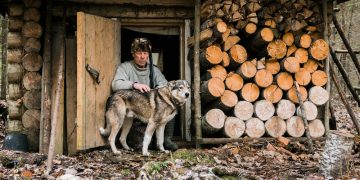
The Lykov family are a family of Russian Old Believers. The father, mother and two children fled to the Taiga forest in Southern Siberia in 1936, in search of religious freedom, after the father’s brother was killed by a Soviet patrol. They spent 42 years in partial isolation.
As of 2025, the sole surviving family member still lived in the wilderness after seeking medical treatment in civilization. (Wikipedia, 2026)
Post-collapse Spiritual Movements
Post-collapse spiritual movements are based in trauma-induced spiritual awakening. People often look to spiritual realm in response to volatility and catastrophe. They also turn to patriotism, charity and volunteerism. This is evidenced by the flurry of such activity in the wake of major disasters such as hurricanes, tornadoes, earthquakes and war.
Losing yourself in service to others starves your own problems, helping put them in perspective and helping both the benefactors of the service and those who perform it. Disaster victims benefit from feelings of belonging and relief from overwhelming grief and loss, that come from participating in spiritual movements post-collapse.
Love is universally embraced as a correct principle by most major religions. Not love, the emotion or feeling, but love the verb. In most languages, love is an action word, something that you do, not just an emotion that is felt. It is expressed through loving actions, such as performing service or through charitable acts.
Wartime Religion
You’ve probably heard the aphorism, “There are no atheists in foxholes.” It is natural for people to turn to a higher power when experiencing extreme stress or fear, but, as with the survival value of faith, belief in a higher power benefits the survivor.
Armed conflict increases participation in organized religion both during and after the actual conflict. As with other forms of volatility, war triggers trauma-induced spiritual awakening, which helps improve our chances of survival.
How to Integrate Faith into Your Survival Preparations
I haven’t shared this aspect of my preparations in an article before, but my own faith affects my survival preparations.
- Consecrated Oil – As I am an ordained minister in my faith, so I carry a small container of consecrated oil on my keyring to administer blessings, when called upon to do so.
- Miniature Scriptures – I also carry a set of military scriptures for my faith in my ruck and a book that includes prayers, hymns and information necessary to hold meetings and administer to congregants in my Go Bag.
- ID – My religion also provides a proof of good standing, which I carry in my wallet, so I can prove to others that I am who I say I am. I have encountered numerous cases where survivors have received aid from churches, including shelter, food, travel, and ID.

Exactly what you should carry, if anything at all, is highly personal choice. It may be as simple as committing a meaningful scripture, quote, poem or prayer to memory. You don’t have to be a card-carrying member of an organized religion to benefit from faith in a survival ordeal. Church membership may have benefits in certain survival situations and be a liability in others.
Summary
The USA was founded on religious liberty. Whether or not faith currently plays a role in your life, survivalists should anticipate the fact that people look to the spiritual realm in times of upheaval and prepare for spiritual needs. What form that will take is highly personal, but the survival benefits of faith should not be discounted. Faith can be a source of unshakeable will to survive and loss of faith can be catastrophic, so students of survival should pay attention to “… the most powerful and universal survival tool.”
Others Are Watching Now:


References
Franklin, J. (2015). 438 Days: An Extraordinary True Story of Survival at Sea. New York: Simon & Schuster, Inc.
Gonzalez, L. (2005). Deep Survival – Who Lives, Who Dies, and Why. New York: W. W. Norton & Company, Inc.
Kamler, M. D., K. (2004). Surviving the Extremes – A Doctor’s Journey to the Limits of Human Endurance. New York: St. Martin’s Press.
Leach, J. (1994). Survival Psychology. London: Macmillan Press Ltd.
Onoda, H. (1974). No Surrender: My Thirty Year War. Annapolis, MD: BlueJacket Books by arrangement of Kodansha International Ltd.
Read, P. P. (1974). Alive. New York: AVON Books, A division of The Hearst Corporation.
Ripley, A. (2008). The Unthinkable – Who Survives When Disaster Strikes – and Why. New York: Three Rivers Press.
Sherwood, B. (2009). Faith. In B. Sherwood, The Survivors Club – The Secrets and Science that Could Save Your Life (p. 317). New York: Grand Central Publishing.
Sherwood, B. (2009). The Survivors Club. New York: Grand Central Publishing.
Wikipedia. (2026, January 31). Lykov family. Retrieved from wikipedia.org:
https://en.wikipedia.org/wiki/Lykov_family