








Animal fat lamps have been around for a very long time, how long, we cannot know, but the oldest evidence, so far, dates to approximately 40,000 years ago. (Mark, 2009) (Matthews, 2025) Animal fat lamps have been used as lighting for so long that Homo sapiens is not the only species of hominin that used them. Homo neanderthalensis used fat lamps and it’s possible that Denisovan man may have used animal fat lamps as well. (Zorich, 2014) (Wikipedia, Animal fat, 2025)

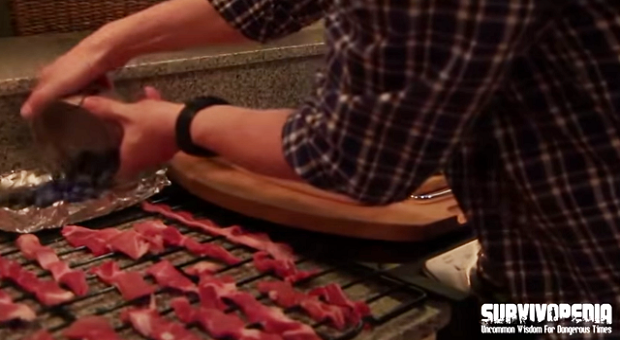
Ancient hominins ate a lot of meat and worked hard to get every ounce of fat out of an animal carcass that they could. Neandertals were using heat and water to extract fat from animal bone in a factory-like setting 125,000 years ago. (Kindler, et al., 2015) A diet heavy in lean wild game makes fat a necessity to prevent protein toxicity.
Fat was used by primitive man for more than just food, it was also used:
- as a lubricant,
- in medicinal salves,
- body paint,
- hair gel,
- leather conditioner,
- moisturizer for dry, cracked skin,
- waterproofing,
- a fire starter,
- and as fuel for lighting for living in caves and for creating cave art.
At some point, tallow was also used to make soap, makeup and perfume.
The earliest animal fat lamps were simply a dab of oil-rich fat placed on a rock with dried plant fibers used as a wick. As a wick slowly burns, the heat melts fat, which is drawn up the wick through capillary action and is vaporized by the hot wick, producing heat and light. As the fat melted, it pooled in natural curves or crevices. This type of lamp is known as an open-circuit lamp.
Next came closed-circuit lamps which featured carved depressions in soft stone to act as a reservoir for the fat and to help prevent spills. These lamps would eventually burn grease from rendered animal fat.
Stone lamps then took more familiar form in carved-handle lamps so the lamp could be more easily grasped and carried.
Eventually, other fire-resistant materials such as clay, ceramics and finally metals were used to make increasingly ornate lamps that burned liquid oils instead of semi-solid fat, tallow or beeswax. Interestingly, the oldest evidence of Neandertals making birch tar is 190,000 years old, so it is reasonable to assume that birch and probably pine tar were also used for lighting in addition to being used as thermosetting adhesives. (Kozowyk, Baron, & Langejans, 2023) Read more about survival uses for pine resin products here. Archeological evidence from caves in France suggests that some caves were lit with grease lamps, while others were lit with pine torches.
Cave art only makes sense when viewed in the dim, flickering, yellow light of lamps and torches with the storyteller moving light source to highlight certain frames or make superimposed images move like a simpler version of early cinema. (Zorich, 2014)
Recreating an Animal Fat Lamp
To make an animal fat lamp, you need a fat (fuel) source, a reservoir, and a wick.
Animal fat was usually rendered into lard, tallow or grease which is then used as lamp fuel. Like beeswax and paraffin, tallow is solid at cool temperatures but melts into a liquid by flame, which can be drawn up through a wick and burned, as happens when a candle is lit.
Fat Sources
Unless you live in Alaska or aren’t above rendering your plus size neighbors, you’re going to have to find a source of fat, and natural sources of fat are less abundant in the lower 48 since populations of bison and brown bears have declined.
Most American game species are so lean that hunters add pork or beef fat to make burgers and sausage juicy enough, but most modern hunters fail to use most of the fat on the carcass.
Most of us are familiar with subcutaneous fat which the layer of fat in the skin, but less familiar with visceral fat (fat packed around the organs), the brain, and fat in the bones and marrow.
Fat was so important to hunter-gatherers that they cracked open the bones of big game animals to get at the fatty marrow they contained so it too could be rendered. Sacajawea taught the men of the Lewis and Clark expedition how to get one las meal out of an elk carcass by making both from the bone marrow, which was one of several times that she helped prevent their starvation. (Howard, 1971)
Some animals that may have usable amounts of fat are:
- Bear
- Feral Pig
- Deer
- Elk
- Racoon
- Possum
- Turtle
- Seal
- Sea Lion
- Walrus
- Whale
- Large Birds
The fat from different animals, and oil produced from it, has varying properties, such as melting point and smoke point. Candlemakers that made tallow candles had to know the melting and smoke points of tallow from the animals that it came from. (Wikipedia, Smoke point, 2025)
Because tallow candles melt in hot weather, a little paraffin wax or beeswax was often added, if they could afford it, to increase the melting point to help prevent the candles melting in hot weather. While tallow candles can provide some food value, in a survival ordeal, nobody wants the rotten stinking mess that results when a tallow candle melts in your pack.
Whale oil differs greatly between baleen whales and toothed whales. Fats that produce a lot of smoke when burned in an oil lamp are not a good a choice for indoor lighting, if you have options. When they were stranded on the Antarctic ice flow, and later Elephant Island, Shackleton’s men burned oil from seals, sea lions and penguins in the confines of shelters and commented that the smoke covered them in a stinky, sticky, black film, but it did enable them to see and cook and generated enough heat to keep them alive.
Reservoir Materials
A good reservoir should be flat to make the lamp hard to tip over and must be made of fire-resistant material.
Early animal fat lamps carved from soft stone such as soapstone, but a seashells and clay were also used. You can use a shallow can such as a tuna can or a shallow ceramic dish or ashtray.
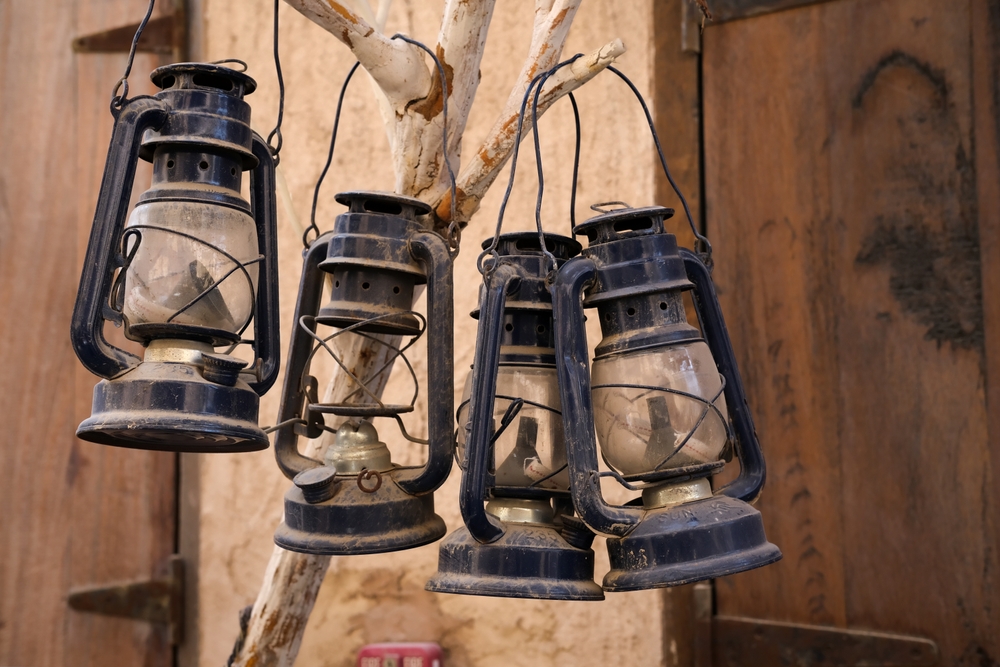
Oil lamps often use glass or metal reservoirs, and you can purchase oil lamp burners that screw onto Mason jars or fit in the mouths of wine bottles to make cheap oil lamps at home by the dozen if you are so inclined.
Wick Materials
Primitive wicks were made from slow burning, absorbent plant fibers which were braided into cordage. Cotton, jute or hemp will work, but if cotton is available, it is the most effective wick material. A cotton mop head from a dollar store contains enough wick material to light your whole neighborhood for some time.
Wider, thicker wicks burn oil faster and produce more heat and light, so most modern oil lamps use flat cotton wicks. Wicks should generally be slightly larger than the opening in the burner. A wick than has been trimmed evenly helps reduce smoke and odor and maximizes the amount of light produced by the flame. As with a campfire, the taller the flame, the more light it produces, but the wick height must be adjusted to prevent smoke. For this reason, commercial oil lamps feature a wheel to adjust the wick height. In a simple animal fat lamp, you can adjust the wick heigh with an awl or pointed stick.
The Oil Lamp
The animal fat lamp eventually gave way to the oil lamp, which is also worth understanding, since you are more likely to use an oil lamp today than a fat burning lamp. Oil lamps also give the survivor additional choices of fuel to burn if there are few animals to be found with usable amounts of fat. The name of the game here is producing light and heat.
Oil Lamp Fuels
When you go to the store and buy kerosene or lamp oil, these products are paraffin oil in different stages of refinement. Kerosene is less refined. The main difference in use is that kerosene has a strong odor, so it is mainly used outdoors. Kerosene and oil lamps vary, but most oil lamps will burn the following fuels:
- Kerosene – Burn outdoors due to the objectionable odor.
- Lamp Oil – Lamp oils are not all equal. Some are odorless, but an improperly trimmed and adjusted wick will cause most lamps to smoke and stink when the wick burns.
- Olive Oil – Olive oil is the best plant oil to burn oil lamps. It is also the safest oil to burn in lamps. Romans added a little salt to dry the oil, making the light brighter. (Encylopedia.com, 2025)
- Vegetable Oils – Expired olive and vegetable oils can be burned for light and heat.
- Seed & Nut Oils – Many of these produce strong odors that compromise scent discipline.
- Whale Oil – Whales have been hunted for at least 3,000 years, but whale oil became an important lamp fuel in Europe in the 1600 and 1700’s until it was gradually replaced by fossil fuels products such as paraffin oil.(Wikipedia, Whale oil, 2025)
If you change fuels, you should also change the wick. A wick saturated with one fuel may not wick another fuel.
Animal fats are hard to locate and procure, so people often lit their homes with lamps that burned available plant products such as pine tar, birch oil or olive oil.
Liquid fuels are dangerous. Olive oil, vegetable oil and seed oils are safest. Do not attempt to use the following fuels in oil lamps as they are too volatile and will cause a fire and/or explosion:
- Gasoline
- White Gas (Coleman Fuel)
- Turpentine
- Acetone
- Diesel Fuel
- Naphtha
- Wood Alcohol(Nubie, 2024) (Jackson, 2025)
Why Burn Oils or Fats for Lighting?
If LED lighting is cheaper, safer, brighter and more convenient than burning lamp oil or animal fat, why invest in the ability to burn oils and fats at all?
- It’s not the strongest or smartest who survive but the most adaptable and being adaptable means having options.
- In certain disaster scenarios, the power grid would be down, batteries would become scarce and your ability to recharge them limited. You’ll always want to have an LED combat light but may not want to waste limited battery power on lighting.
- Burning oils or fats produces heat. Some models of lamps feature cook tops, and the average oil lamp puts out nearly 200 BTUs/hour (depending on wick width and fuel). That’s as much heat as an electric space heater on the low setting. That’s a big deal when central heating is down and the farther north and higher in the mountains you live, the bigger deal it becomes! My favorite way to capture small amounts of heat is to heat water, which I pour into a hot water into a hot water bottle and then place it at my feet in bed.(Joye, 2025)
- It’s fun! Oil lamps and candles are comforting. Essential oils can be added to produce pleasant scents and dyes add a splash of color. Maintaining morale is survival situations is crucial so take any win you can get.
I burn oil lamps and candles all the time, and my wife tolerates it because it helps warm the room. She grew up in Brazil and every home had a few simple oil lamps that were lit during frequent power outages.
Some of the brightest oil lamps are made by Alladin. They feature hollow wicks and mantles and are as bright as a 60w light bulb. We maintain an Alladin lamp to light the main room of the house and regular oil lamps for each family member.
Summary
One might think that cheap, safe LED lighting would totally replace animal fat and oil lamps, but people (myself included) are still making primitive animal fat lamps and making or buying oil lamps and candles and I don’t see them going away anytime soon.
Just as it is important to learn primitive survival skills such as fire by friction and braiding cordage, it is important to learn to make light with animal fat lamps and pine or birch torches or lamps as our ancestors did. Understanding the basics is fundamental to both our understanding and the survival of our species.
Others Are Watching Now:





References
Encyclopedia.com. (2025, December 1). Lighting the Ancient World. Retrieved from encyclopedia.com:
https://www.encyclopedia.com/science/encyclopedias-almanacs-transcripts-and-maps/lighting-ancient-world
Howard, H. P. (1971). Sacajawea. Norman, Oklahoma: University of Oklahoma Press.
Jackson, G. (2025, September 20). Whaling – human predation. Retrieved from britannica.com:
https://www.britannica.com/topic/whaling
Joye. (2025, April 14). Do Oil Lamps Give Off Heat? The Surprising Truth. Retrieved from heaterguides.com:https://heaterguides.com/do-oil-lamps-give-off-heat/
Kindler, L., Gaudzinski-Windheuser, S., Scherjon, F., Garcia-Moreno, A., Smith, G. M., Pop, E., … Roebroeks, W. (2015, July 2). Large-scale processing of within-bone nutrients by Neanderthals, 125,000 years ago. Retrieved from science.org:
https://www.science.org/doi/10.1126/sciadv.adv1257
Kozowyk, P. R., Baron, L., & Langejans, G. H. (2023, September 7). Identifying Palaeolithic birch tar production techniques: challenges from an experimental biomolecular approach. Retrieved from nih.gov:
https://pmc.ncbi.nlm.nih.gov/articles/PMC10485052/
Mark. (2009, October 19). Fat Lamp. Retrieved from nehawkaprimitiveskills.blogspot.com:
https://nehawkaprimitiveskills.blogspot.com/2009/10/fat-lamp.html
Matthews, M. S. (2025, June 16). European Oil Lamps from Prehistory through the Viking Age. Retrieved from oak.atlantia.sca.org:https://oak.atlantia.sca.org/european-oil-lamps-from-prehistory-through-the-viking-age/
Nubie, S. (2024). Things You Can Burn In an Oil Lamp. Retrieved from homesteadsurvivalsite.com:
https://homesteadsurvivalsite.com/things-you-can-burn-in-an-oil-lamp/
Wikipedia. (2025, November 25). Animal fat. Retrieved from wikipedia.org:
https://en.wikipedia.org/wiki/Animal_fat
Wikipedia. (2025, October 21). Smoke point. Retrieved from wikipedia.org:
https://en.wikipedia.org/wiki/Smoke_point
Wikipedia. (2025, October 31). Whale oil. Retrieved from wikipedia.org:
https://en.wikipedia.org/wiki/Whale_oil
Zorich, Z. (2014, February 28). Early Humans Made Animated Art. Retrieved from nautil.us:https://nautil. us/early-humans-made-animated-art-234819/